In Part One, we examined the need for choosing a Health Care Proxy and making decisions about your Advanced Directives. In Part Two, we examined the realities about CPR and artificial nutrition. Those are the big decisions that you need to make, but there are other things you may want to consider and put in your Advanced Directives/Living Will.
Hospital Transfers (Do Not Hospitalize order): If you are in a nursing home or even receiving treatment at home, you or your HCP can request a Do Not Hospitalize (DNH) order which is basically what it says. If you were to become acutely ill, you would not be sent to the Emergency Room for evaluation and treatment, but be treated where you are, non-aggressively. Hospitals can be a crappy place to spend your last hours. Busy, noisy and intrusive not to mention frightening to someone with dementia or really anyone in crisis. Hospitals are not the place for a peaceful death – if that is your goal. However, without an explicit order, it’s possible that you may get sent in by a skittish provider who is not familiar with you or your wishes.
No Diagnostics or Treatment: You can also ask to have no diagnostic work – blood work, x-rays etc. And request not to be treated for such common ailments as a urinary tract infection or respiratory infection. You may decline surgery, dialysis, blood transfusions and medications.
Organ Donation: Please, please, please be an organ donor. Let your family know of your decision and register as an organ donor. Even if you or your loved one has been sick for a while, they may still be eligible to donate skin, tissue or corneas. There is a myth that if you register as an organ donor, the ER staff will not work as hard to save you. Nothing could be farther from the truth. ER doctors and nurses live to save lives. It’s what they do, it’s who they are. Trauma unit staff take it personally if they can’t save you. It’s all they think about. They are not going to let you die if there is a single thing they can do about it. So please don’t not register because of this urban legend.
There are always going to be situations that don’t fit into the categories we have discussed. Again, I will recommend Five Wishes. This tool helps you think about life and death and what you priorities are. You can also use it to think about what a loved one may have wanted, if they haven’t expressed their wishes beforehand.
Nothing is harder than to have to make these decisions for someone you love. Please try to talk about this with you loved ones. Even if you can’t talk about it directly, try to understand and appreciate what makes life worth living for them, what their spiritual beliefs are so you can make the best decisions should you ever be in that position. And always remember it’s about the person who is sick, not about you. What would they have wanted? How would they want to live or die? What was important to them?
For anyone who is going through, or has gone through this, you have my deepest sympathy. I hope you are able to find peace and feel that you have done the best for your loved one.

As promised, an excerpt from my own advanced directives:
In the event that I
a) Am in a terminal condition caused by illness or injury and have no reasonable hope of recovery or becoming aware of my surrounding or being able to use my mental abilities and/or;
b) Have a progressive illness which will continue to worsen and result in my death and which cannot be improved or cured –including, but not limited to, progressive neurological diseases including, but not limited to: Alzheimer’s, Parkinson’s, ALS, MS, or any form of dementia and/or;
c) Have any condition that makes me unable to recognize people or to speak understandably and this condition is permanent and cannot be improved or cured, but is not considered in and of itself to be terminal, including, but not limited to, a persistent vegetative state, coma, severe stroke, injury or the progressive neurological diseases or dementias listed above, my wishes regarding medical intervention are the following:
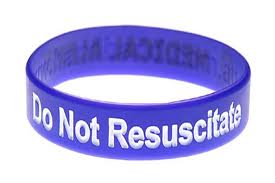
No resuscitation (no manual, electrical or chemical cardiac resuscitation)
No intubation or any form of respiratory support (see below re: oxygen
No dialysis, no blood transfusions
No surgery for any reason or condition
No oral or IV/IM antibiotics or any other medications given with the intent of saving or prolonging my life. Any underling medical conditions such as (but not limited to) diabetes, hypertension, DVT should not be treated, nor do I wish to be treated for any acute illnesses including (but not limited to) urinary tract infection or respiratory infection.
No artificial or supplemental nutrition or hydration in any form or via any mode of delivery.
No diagnostic testing or monitoring whatsoever. No blood work, no imaging nor any other test invasive or non-invasive to diagnose any illness or condition.
If I am in a skilled nursing facility, sub-acute or rehab hospital, no transfers to any acute care hospital or emergency department for care or evaluation under any circumstance.
I DO, however, wish to be given any medication, including, but not limited to, narcotic and/or non-narcotic pain relievers, benzodiazepines, anticonvulsants or similar medications IF the sole purpose is to decrease pain and/or increase comfort. As a nurse, I fully understand that these medications often, when used in amounts necessary to fully ease suffering, may hasten or even cause my death. I also authorize the use of oxygen so long as it is being used for comfort measures and not for prolongation of life.




 1886: Oskar Kokoschka: When I was in art school, we had a thing wherein we’d go behind someone, push them lightly on the shoulders, not enough to make them fall down, but enough to scare them, and scream Oskar Kokoschka’s name. It was an act of absurdism in the name of the master of German Expressionism and the idol of myself and several of my friends. The painter, poet and playwright was originally told that he was mentally unstable after being injured in World War One, but aren’t all the greats? I know that I’m pretty mentally unstable. Who wants to be stable? Perhaps its my idolatry of Kokoschka that has led to my allowing myself this instability. Anyways, the Nazis deemed him and his work degenerative, so he escaped to Prague, until the Czech began to mobilize for an invasion from Germany and he escaped to the United Kingom. His style was very nervous, but filled with great motion and intrigue and his play is considered the first Expressionist drama. The individualism displayed by himself and Max Beckmann created one of the greatest offshoots of the Modern Art movement, though Kokoschka saw himself as a footnote in the annals of art history towards the end of his life which made him bitter. Here’s an example of his work: The Red Egg, 1941, currently in Prague’s Narodni Gallery:
 1987: Ke¢ha: That girl who always looks really dirty and sings about brushing her teeth in the morning with a bottle of Jack Daniels because she’s a complete alcoholic turns 24 today! Ke¢ha is a terrible idol, mainly because while she’s had great success, she’s not particularly talented. I like Ke¢ha when I’m driving and not wanting to listen to WRCJ or WOMC, but that’s about it. There’s no substance. Still, she has more money than we could dream of, but hey, I like her better than Gaga so there’s that.
 Ashlee Simpson’s baby naming idol was kidnapped as a kid by the King of England as a pledge for the continued good faith of Gryffydd’s father Llywelyn the Great. Griffid. Gryefehd. Gryffindor.
  1980: Wilhelmina Cooper: An icon amongst models and the idol of every aspiring girl, Wilhelmina Cooper, founder of Wilhelmina Models, and the woman with the most Vogue covers: 28. She appeared on 255 covers during her career, launched Naomi Sims, the first black supermodel and was portrayed by Faye Dunaway in the movie Gia about another model Wilhelmina’s agency launched to stardom, Gia Carangi who later died of AIDS.
 1984: Jackie Coogan: A comedic idol! Jackie Coogan was a stah! A child stah! With all the child stah problems like having his parents steal his earnings. Naturally, he sued them, got very little of the money he earned and got a bill named after him that requires 15% of child star earnings to be placed into a trust. He’s best known as Uncle Fester on The Addams Family, but he was also Oliver Twist.


 1824: Blondin: Humpty Dumpty sat on a wall. Humpty Dumpty had a great fall. All the King’s horses and all the King’s men couldn’t put Humpty together again. This French tightrope walker didn’t die from a fall, but he did have a fall that ended with the death of two people. It’s such a shame when the good intentions of entertainment lead to death. In 1861, while performing 50 feet above the ground, the rope he was on broke, causing the scaffolding to fall. Blondin was not injured, but two workers who were on the scaffolding fell to their deaths. An investigation occurred in which no fault was put onto Blondin or his manager. However, the judge said the rope maker had a lot to answer for. The man who ran the venue where the incident occurred vowed never to have a spectacle of that sort ever again, yet, Blondin was back the next year doing a tightrope walk 100 feet above the ground even though there was a bench warrant against him and his manager for not appearing at a trial in regards to the earlier, deadly incident as they were touring in America at that particular time. Blondin enjoyed a successful career until his death some thirty years later.


 1891: George Hearst: Georgie Boy had good intentions. He wanted the American Dream™ and he lived the American Dream™. He became a successful miner and investor and became a United States senator: The American Dream™. He more than provided for his family including, and this is where his good intentions took a turn for the worse, his son William Randolph who became a newspaperman and championed yellow journalism and that’s why we have stuff like the NY Post. Ugh. Hate you George, but mainly because we blame you for bad puns in headlines. You yourself are pretty awesome and a good role model for all us prospectors headed towards California, which would be us! Announcement: We’re moving to California to find gold!
 1965: Emile Buisson: The French! Always surrendering! Well, this one had terrible intentions and he didn’t so much surrender as he was caught, but, then again, he didn’t kill them all when they closed in. He surrendered himself. Just like the French are wont to do. Anyways, Emily was a French gangster who killed a lot of people, and by a lot of people, we mean a lot of people. Like, more than thirty people. That’s a lot of people! What bad things can happen from good, we mean, bad intentions.


 Today on Life, Death and Violence: Men! And the manliest man thing of all? Sports! Yes, little birds, today we’re covering sports history. Throw that baseball into the endzone and make sure you don’t go offsides so you can get that service ace! Touchdown! These are sports things, right? Our sports memory has been hazy ever since that time in the fourth grade when our father made us go to Little League practice and we told him we didn’t want to do it anymore, but we went and got hit in the eye. We had to get stitches and then perform as Young Cain in Children of Eden that very night. Sports! The glory of victory and the suffering of defeat or something like that. Come running with us and Joseph as we explore this mystical world.







 1965: Malcolm X: The original spokesman for Ray-Ban® Clubmaster™ was assassinated in New York.
 1974: Tim Horton: We’re at a loss for words, dear friends. This wasn’t just a man. This wasn’t just a hockey player. This was the man who created Tim Horton’s Coffee and Donut. We owe such a debt to this man. We wouldn’t have functioned in high school if it weren’t for the combination Wendy’s/Tim Horton’s across the street. We even went as a Canadian robot one year for Halloween. Its name? Tim-Bot 3000. Yeah, we named him after TimBits. We’re going to go get an iced capp right now in his honor and we think you all should too, assuming of course, you’re near a Tim Horton’s. We know that LeZig is because she’s in Toronto, that most Canadian of all Canadian cities. We bet there’s even two that are across the street from each other like there used to be for Starbucks in New York until The Dark Times. You be safe up there Timmy Ho! We’re pourin a little coffee on the ground in your honor. Don’t worry, we’re doin’ it over a sewer so as not to cause a mess, eh. Wouldn’t want to not be polite. Peace, Timmy. Peace. You’re a golden man and we’ll love you forever.


 Yoko Loves You. We Love You Back Yoko and We’ve Written You a Haiku