***SPOILER ALERT***
Wednesday night, I attended a free screening of Red Riding Hood. The following review is chock-full of spoilers. It pretty much gives away everything other than the identity of the wolf. If you are heavily invested in seeing Red Riding Hood with unbiased eyes, do not read on. I’m assuming very few of you fall under that category, however, so here we go.
Red Riding Hood is Catherine Hardwicke’s first project since directing the premier installment of the Twilight series. The Big Bad Wolf in this version has been transformed into a werewolf, so naturally, comparisons between the two films are running rampant. Red Riding Hood does indeed have a lot in common with Twilight. Sadly, however, I’d say Red‘s the less entertaining of the two.
From the very beginning, the dialogue clunked along, much of it boring lines you’ve heard in other movies, such as the oft-cried “I don’t want you to see me this way!” Even new lines didn’t resonate. An exchange meant to ramp up the tension between the two male rivals (“If you’re the wolf, I’ll chop your head off” / “I’ll do the same.”) A heavy-handed attempt to make the audience think one of Red’s suitors is the wolf (“I could eat you up.” You know, LIKE A WOLF.) There were very few lines that elicited laughs, genuine or ironic.
Where and When is Grandmother’s House?
My friend and I both left the theater unsure of where and when the movie took place. Seventeenth century England? Sure. Twelfth century Italy? Why not. I’m now leaning towards France in the late-Middle Ages.
The costumes don’t make it much easier to figure out. Similar to A Knight’s Tale, the costumes mix a Renaissance fair aesthetic with modern touches. But without the charm and cheekiness of A Knight’s Tale, some of the costumes just feel tacky.
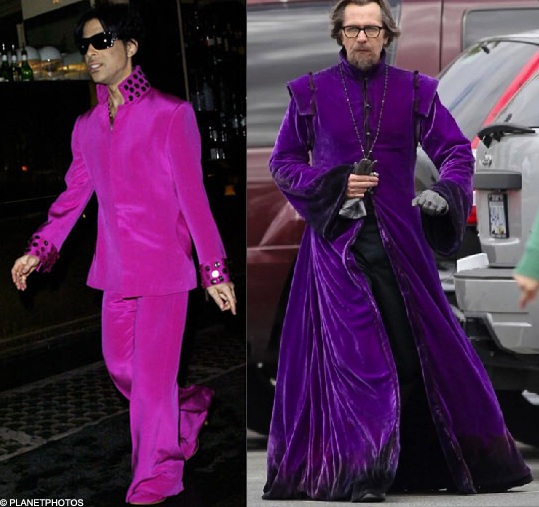 Gary Oldman dons a purple velvet number that I’m pretty sure was borrowed from Prince.
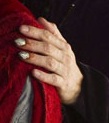 He completes the outfit with silver-tipped fingernails (the better to scratch werewolves with, my dear.) Tunamelt does it better.
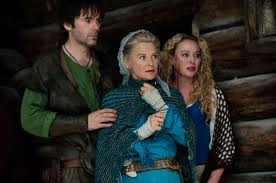
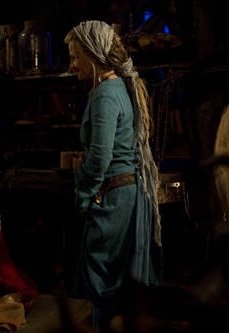 Meanwhile, Red’s grandmother moonlights as a Boho yoga instructor.
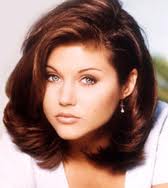
Speaking of anachronisms, Little Red’s real name is Valerie. Wikipedia tells me that Valerie does in fact have old origins, but really, when I hear Valerie, there’s only one person I think of. And she may have been a saucy wench, but she was most definitely from the modern age.
Twilight: Part 2 (Part 5? Whatever.)
After reading Twilight the book (I was curious, okay!), I was actually impressed with Hardwicke’s ability to transform the discombobulated, nonsensical source material into something vaguely coherent and watchable. Sure, the movie’s still drivel, but the kind of drivel that’s good for a few giggles, maybe after sneaking some Schnapps into the movie theater. Red Riding Hood can’t claim the “so bad it’s good” title. It’s just so bad it’s bad.
That said, the two films do have a lot of noticeable similarities. The movie opens by panning across the tops of tall, lush tress, not unlike the ones Edward and his “spider monkey” climb. The heroine is courted by two good-looking young men, one fair (Henry) and one dark-haired (Peter). There is no clear good or bad guy among the two. (Unless one of them turns out to be the wolf!) Both are seemingly nice enough fellas, but lack any real defining personalities other than liking her enough to risk their lives. Despite not trusting each other, at one point they have to join forces to rescue the object of their affections.
Redeeming Qualities
There’s a scene where the townspeople hold a bacchanalia-like party that reminds you that Hardwicke also directed Thirteen. There, Valerie engages in the ancient courting ritual – dancing all up on another girl to make a boy horny with jealous rage. Hardwicke does a good job creating a chaotic, animalistic scene, and I think she’d be well-suited to direct a darker teen movie, like Cruel Intentions.
Random Absurdities
- Valerie’s sister is killed by the wolf early on. From the start, the sister’s unrequited love for Henry is emphasized. Later, you learn that she and Henry are half-siblings. The characters continue to speak of her love, despite the fact that he was her brother and that is gross.
- Paranoid that he may be the werewolf, Valerie stabs her almost-lover Peter. You’d think that this would lead to a conversation about her trust issues, but instead, Ol’ Pete seems totally unfazed.
- Blond Grandmother looks exactly like the blond Red Riding Hood, who looks exactly like her blond mother. Turns out Grandmother is actually Valerie’s paternal grandmother. Another unexplored incest storyline perhaps?
- Three-fourths of the way into the movie, you learn the wolf can speak telepathically to Red. Surprise!
If you’d like to see the telepathic werewolf for yourself, Red Riding Hood opens Friday.
Top Image from here.
 We’ve long had a fascination with the plight of the werewolf. The whole concept of man turning into a large beast, well it’s the things of nightmares and really good movies. In my opinion there is nothing like seeing a really great werewolf transformation. It is the pinnacle of any movie featuring werewolves. We all wait to be awed by the technique. And we feel totally let down if the transformation doesn’t strike the right note of fear, shock, pain, and horror. I consider myself a werewolf purist in this regard. I can instantly tell when a transformation is going downhill. Mostly when you don’t see it happening. If a movie glosses over the transformation, then well, they’ve not done their movie and the genre service. If one minute there’s human and the next there’s wolf (especially a traditional quadruped wolf) then they’ve blown it.
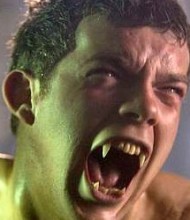 Aside from any werewolf blasphemy, I love discovering a new entry worth its salt. The latest on my “super spectacular” wolf list is the UK version of Being Human. While the American version tries to stoke the same fires, it’s really the UK version that sails into respectable wolf genre territory. I’m halfway through the second season (So no one ruin the third season for me) and I’m pretty impressed so far with the wolf character “George” played by Russell Tovey. He strikes the right balance of fear, shame, and eventual acceptance of his curse. The horror and resignation is there, but also this sort of subtle charm that belies the real “monster” he can become. There is no CGI (Computer Generated Images) for the audience to lazily rely on. For a television show, an albeit gritty and no-holds barred television show, the graphic detail is phenomenal and the use of traditional special effects is impressive.
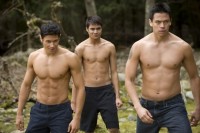 Werewolves in movies are not the sole interpretation of the likes of Stephenie Meyer and her bevy of non-shirted hunk-wolves. No, cinema and television have been the birthplace of the wolf for generations. And each new generation adds just a bit more to the lore to make a complete compendium of wolves from bipeds to quadrupeds, to full shifters to half shifters, to teenage wolves, wolves backpacking, girl wolves, boy wolves, middle aged wolves, medieval wolves, and King of Pop wolves — the curse runs the gamut.
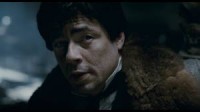 But as we get even further into the 21st century the evolution of the werewolf is bound to take on even new shapes so to speak. Werewolves have often played second fiddle to their fellow monster brethren. Vampires have taken over the show, Zombies and their penchant for apocalypse have overshadowed the wolf, and aliens still manage to rake in movie dollars. The plight of the werewolf in modern times has been significantly reduced, mostly landing them in the B-movie category. Or shamefully worked into an overwrought period piece with not enough new elements to add to the genre, and relegating it to workable CGI (that they’ve built the whole movie on) and stunted acting from the stars of such film. See: Benicio Del Torro and Anthony Hopkins in a remake of The Wolfman. But I think the return of the wolf is coming, because just how many beautiful undead creatures can we really watch, and just how many chemical outbreaks can cause the Walking Dead? Somewhere, someone will establish a righteous ode to the moon cursed. And I’ll be waiting.