In both the comments and on the Facebook group I’ve noticed a recurring theme. Many of you seem to be having trouble with image uploading/editing. Even if you’re not a writer here this should provide some useful information.
For the thumbnail the image needs to be 455 pixels by 280 pixels. This will be at 72dpi. Easily put, dpi is a big part of the picture’s resolution. Let’s not go into dpi too much, just know that the web operates at 72 as a standard. This also means that if you want an image to take the whole column spread of your article it will need to be 455px as well and at full-size. Full-size is one of the picture editing options when you upload it.
When you re-size a picture watch your relative size. If it starts out tiny just because you can make it bigger doesn’t mean it will look good. Visible pixelation is not pretty! You will have to eyeball this which means you need a decent imaging program. Many of you have Photoshop I’m sure, and as the industry-standard it’s indeed dandy…if you know how to use it properly. However, Photoshop is expensive and I will not be writing an article on how to get a hacked copy anytime soon. Uh…try 4chan at your own risk? I dunno. Seriously, don’t. Therefore I have a couple of alternatives because if you are using MS Word or the ilk, you’re doing it wrong.
If you are on a PC you can use Thumba. You will need to install Silverlight first but if you stream Netflix you already have it, so not a big deal. Thumba is one of the best online image editing free-services I’ve found. Easy to learn, fairly intuitive, not an eyesore, unfortunately though…not for Mac.
If you’re on a Mac or just want something more heavy-duty try GIMP for Mac or PC. Gimp is damn near Photoshop for free. It’s an absolutely brilliant program. I can’t believe they give it away. It’s less user friendly than Thumba. Steeper learning curve. You might actually have to read the accompanying information a little but it’s great if you need to actually alter or repair your images which I’d not suggest on Thumba per se. Gimp also has a huge cult following including brushes & scripts on DeviantArt if you want to play!
I will happily answer other image editing questions. Keep in mind I am not a WordPress expert, just a computer artist.
Edit: Looks like the image source on a few different browsers actually lists the final header image size as 600×260 pixels. I apologise for using erroneous information!
If you are like me, you spent some time in your twenties jumping from job to job, and then found “the job” where you decided to settle in and hang out for a while. If you have been at your current job for more than five years, this article is for you.
While this article can apply to any line of work, my experience is in IT, so that’s my focus. What I have learned is, there’s no “career counselor in the sky” who is going to help you get the skills you need to stay employed. You can’t count on your employer to pay for classes, and you can’t count on anyone to let you know what’s going to be the industry standard in the next five to ten years.
What does this mean? This means you have to actively manage your career and your skills. Aw, man! I know. It’s a pain. But if you are considering taking a break from actively managing your IT career, just remember one word: COBOL.
While this ’50s-era programming language is still used today, it symbolizes the way a seemingly omnipresent technology can be in demand one moment and out of fashion the next.
What happened to me? I worked at one company for fifteen years, and had many different roles — system administrator, webmaster, network manager, team lead. In the end, I was laid off and left with skills that were not too attractive to employers as they once were.
What should I have done? A few things. First, I should have kept track of what skills employers are looking for, and getting trained in those skills on my own time and my own dime. I thought that because I was really good at what I did, that was enough. Wrong-O. After getting over the shock of being laid off, I took out my annual reviews where I listed all the things I had done each year, and then compared that to what I saw in listings on Dice.com and Monster.com What a wake-up-call.
Next, I should have been maintaining a network of contacts outside of my employer. I did a half-hearted job of this and did not have a strong network of people who could help me find my next job when I needed it. I ended up working with recruiters and while that worked for me, it took me much longer to find the right recruiter than it would have if I had had someone to refer me to them.
Last, I should have been looking outside my company for my next job long before I started my job search. I knew things were winding down, but I still waited to try to find a job until a point about a year before I was laid off. It just so happened that the very time I started looking for jobs was the beginning of the massive waves of layoffs during the recession, so score one for my impeccable timing.
Here are some things I am doing today.
Schedule time to keep up with industry trends
If you want to avoid being overrun by shifting technologies, you need to keep up with news. Spend some time reading about trends in your line of business, and about trends in your line of work. I subscribe to newsletters from Microsoft (since I do a lot of work on Windows) as well as Sun, EC Council, eWeek and c|net. Keeping in touch with trends in your line of business helps you know what’s coming. Compare what you read in the press with what skills are listed in current job openings.
Lateral moves are not bad moves
If you want to stay at your current employer and there’s a way to move to another department or division, that’s a great way to get some on the job training. I used this strategy several times in my career to get out of a position that was not challenging, while getting experience that would be valuable later on. These days, I am still doing technical work, but I’m also doing project manager and team lead work.
Bite the bullet and pay for your own training.
Unless you’re looking to move into an entirely different career (and start over from zero), avoid training yourself in something entirely new. It’s more efficient to build on what you already know — for example, if you are a data base analyst, learning java or c++ so you can code stored procedures is a great way to extend your skills. Again, look at Dice and Monster and see what skills are listed in current job openings. That’s your clue when thinking about what training to sign up for. I like to keep an eye on the offerings at the local community college — the price is right and the time investment is small. I was lucky to take a c++ class taught by one of the people who wrote the language, and now is teaching the language in her retirement.
Spin interviews the right way.
I emphasized my participation in beta programs (Windows 7, anyone?) and the breadth of my knowledge. When someone asked me why I stayed at my last job for such a long time, I told them that the work was challenging, and because technology kept changing, it was like having a new job every year, without having to start over at a new company. I told them how I made a difference for my former employer, by saving money, eliminating outages, etc.
Your resume is not cast in stone.
Instead of a chronological resume, try writing an experience resume. This type of resume documents the value you brought to former employers — projects completed, deadlines met, budgets managed, costs saved — rather than the particular skills you used to accomplish those goals. You can include your skills, of course; they’re part of your history in the industry. But don’t present them in such a way as to indicate they’re the reason you should be hired.
Hi gang. Here is your Hump Day post to keep your motor running. Please at least shut the door to your office before you get reprimanded again. Here are some nice young men and women being naughty for you.
Betty this one is for you.
You are going to probably need some of this later. Have a great day.
We’ve been hearing on the news since the earthquake/tsunami/all around shitty time in Japan started. However, have you wondered why these explosions are happening? Well, I’ll attempt to explain it.
To break it down, fuel rods in a nuclear reactor are composed of zircoloid containing uranium dioxid The uranium used in nuclear power plants, uranium 235, is a highly charged, fissile element. When an element is fissile, it means it can sustain a fission chain reaction, so when the neutron (the tiny part of an atom that exists within the nucleus of said atom) touches another nucleus of uranium 235, a chain reaction occurs; causing energy release that can be harnessed via nuclear power plants. Now, as anyone who has ever broken a sweat by way of physical effort knows that energy release creates heat, thereby making these fuel rods, well, wicked hot.
Don't try this at home.
Because these fission reactions can cause explosions, and to keep these rods from completely blowing up, the fission reaction is slowed down by control rods composed of boron, cadmium, and hafnium. These elements can absorb neutrons, slowing the collision of the nuclei, and diminishing the power of the uranium rods.
In fact, if they become hot enough, they can swell and crack, which would cause radioactive gases (caesium and iodine) to escape, which is bad news bears for everyone. So, a system had to be devised to keep these rods cool enough to; 1) not incinerate everyone in the area, 2) not melt a radioactive hole in the ground, and 3) not give everyone radiation poisoning.
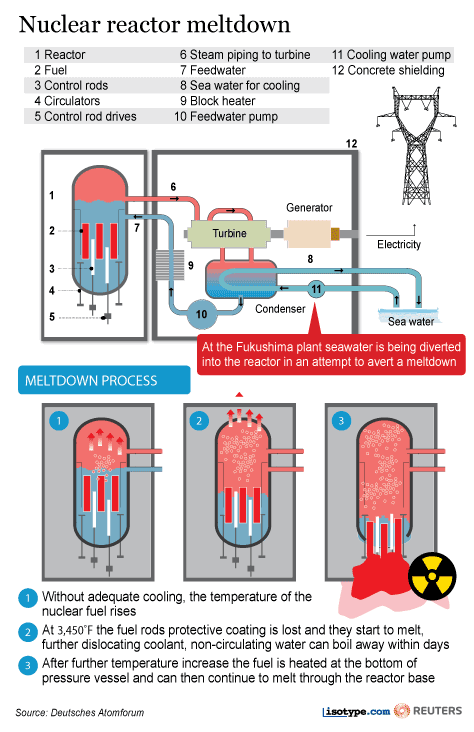
And how do they do this? With water, glorious water – is there anything it can’t do? The Water is pumped into the reactor, which contains the insanely hot uranium rods, and is contained in a concrete housing. To give you an idea of how effective concrete can be in protecting us from radiation; it’s what is keeping the Chernobyl reactor sealed off after their disaster in 1986. Before you start to worry this will end up like Chernobyl, it’s not likely. The reactors in the Chernobyl plant were not surrounded by any remotely effective barrier, leaving everyone completely unprotected from any sort of accident. The Japanese know more, and are more careful than the people who ran the Chernobyl plant, so the risk is significantly lower. However, the potential danger of the situation should not be underestimated, and per the graphic I “borrowed” from MSNBC, who borrowed it from Reuters, it looks like even the concrete containment unit won’t be guaranteed to always be able to contain the melted uranium. There are several more things that have to happen for the situation to get to that point, but there’s a lot of chaos, a lot of danger, and a lot of unknowns at the moment.
Thank you, MSNBC
*ahem* So, the reactor has pumps for both the control rods and the circulators which, surprise surprise, circulates the water around the rods which enables them to cool more effectively than standing water. The heated water turns into steam in the reactor, which is then pumped out through the turbine to the condenser where the steam is converted to water once again. Lather, rinse, repeat.
Because of the earthquake, the pumps in the reactor moving the cooling water failed, thereby allowing the uranium rods to overheat and produce excessive hydrogen-containing steam. As the rods continue to get hotter due to the lack of circulating water, steam increases, as does the pressure inside the reactor. The pressure then makes it impossible to pump more water into the reactor. So, the engineers, with the intention of avoiding a meltdown, allowed some of the steam to vent out of the reactor and into the environment. The downside is the steam releases radioactive elements into the environment, hence the warnings to stay indoors and/or evacuate.
Now how does all this relate to hydrogen? When the zircoloid tubes containing the uranium dioxide heat up, they react with the cooling water to form hydrogen which builds up in there steam. As anyone who is familiar with the Hindenberg knows, Hydrogen is extremely explosive, so excessive pressure inside the reactor+ a teensy bit of hydrogen escaping the reactor = big explosion.
If the water levels continue to drop within the reactor, the uranium rods will overheat and melt down through the reactor. The good news? The melted uranium will stay inside the concrete containment unit, as happened at Three Mile Island.
Is there more? Absolutely. Can I fill you in on more? Probably not much more than this without a ton of research, and they don’t pay me enough for that. In fact, if anyone else notes any inaccuracies in this article, please point them out in the comments. I did my best to explain this correctly, but being that my background in this includes a little college-level physics, a nuclear engineer bff, and a general curiosity for the subject matter. There are a number of good resources on both Japan’s nuclear plants as well as nuclear power on the internet from actual nuclear scientists that should be able to add more information, should you wish to seek it out.
World Nuclear News is an industry newsletter which has quite a bit of interesting information, as well as frequent news updates regarding the situation in Japan. Interestingly enough, they’re also on facebook.
In addition, many news websites have good information in relation to the incident. BBC News, Reuters, MSNBC, and Kyodo News have been rather informative.
Note: I am working today until 4PM EST without access to a computer. So if you comment and I don’t respond, it’s not because I don’t care, it’s because I can’t see it before 4. Where’s that computer chip for my brain?
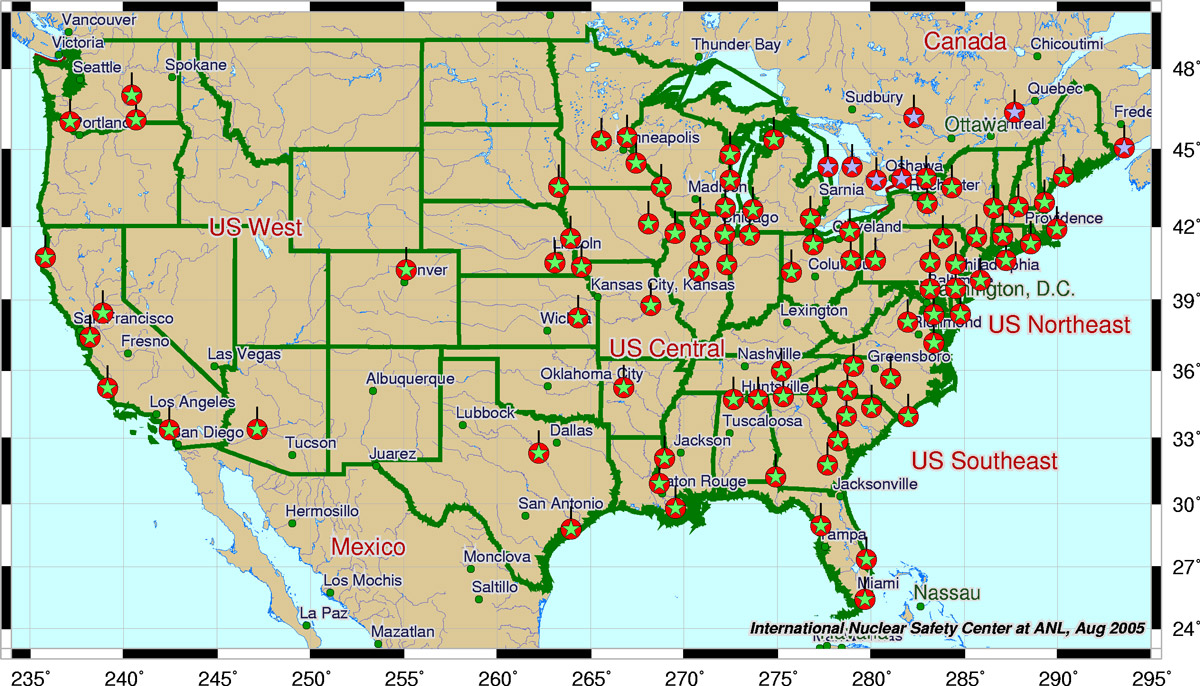
Where are all these nuclear power plants that have been the cause of so much speculation? Maybe in your back yard. A full list is available at Wikipedia.
The first map is courtesy of Argonne National Laboratory. It show the location of all plants active and inactive, well except the ones that government doesn’t want us to know about. Closed plants are still not the kinds of places you want to build playgrounds and swimming pools.
Click image to enlarge
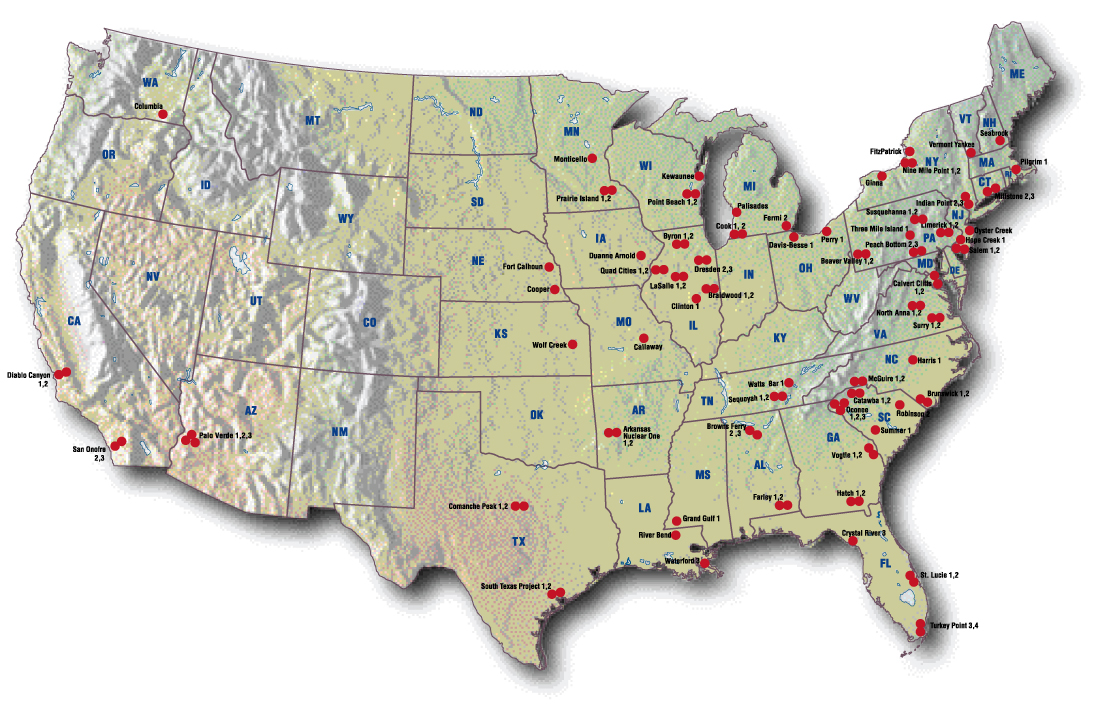
Next we have a nice map from world-nuclear.org. This one shows only plants that are up and running.
Click image to enlarge
Many of the older reactors have been shut down as they become too expensive to maintain, obsolete or go past their permit date without an extension. The cluster of dots on many locations are to show the multiple reactors per location.
From world-nuclear.org:
The USA has 104 nuclear power reactors in 31 states, operated by 30 different power companies. In 2008, the country generated 4,119 billion kWh net of electricity, 49% of it from coal-fired plants, 22% from gas and 6% from hydro. Nuclear achieved a capacity factor of 91.1%, generating 805 billion kWh and accounting for almost 20% of total electricity generated in 2008. Total capacity is 1088 GWe, less than one-tenth of which is nuclear.
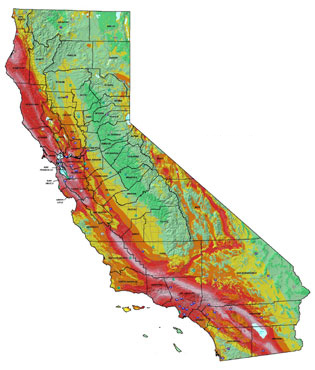
The recent tragedy in Japan has many people in earthquake prone areas of the US wondering if they should purchase earthquake insurance. Let’s look at the likelihoods, costs and benefits. We’ll look at California because data is readily available and Cthulhu’s wrath has been predicted to be focused on the San Francisco Bay Area.
Source conservation.ca.gov
How Likely Is an Earthquake?
“Probabilistic seismic hazard maps… are typically expressed in terms of probability of exceeding a certain ground motion. For example, the 10% probability of exceedance in 50 years maps depict an annual probability of 1 in 475 of being exceeded each year. The maps for 10% probability of exceedance in 50 years show ground motions that we do not think will be exceeded in the next 50 years. In fact, there is a 90% chance that these ground motions will NOT be exceeded.”
But, a smaller amount of ground movement is more likely and is almost certain to happen at some point in the next 30 years.
The red ares of this map are the highest level of ground movement and line up with large population areas. The conclusion is that shaking will occur, we don’t know when and we don’t know how bad it will be.
That gives rise to the need to mitigate the risk of property loss when an earthquake does happen. But what exactly does earthquake insurance cover and how much does it cost? Those factors are driven by coverage levels, structure replacement value and location.
What Does Earthquake Insurance Cover?
Repair, or in the event of a total loss, replacement cost, of an insured home when damage exceeds the policy’s deductible, up to the policy limit.
If you cannot live in your home after an earthquake, you may be eligible for additional living expenses up to your policy limit.
After the deductible has been met by covered damage to your home, the policy will replace personal property such as furniture and household items, up to your policy limit.
Your policy will pay up to $10,000 (as part of the dwelling limit of insurance), including engineering costs, to replace, stabilize or restore the land that supports your home.
What Does Earthquake Insurance Not Cover?
Detached garages and most other structures that are not part of the dwelling itself
Land damage, other than $10,000 in coverage for land stabilization
Swimming pools and spas
Awnings and patio coverings
Fences
Certain decorative or artistic items such as mirrors, chandeliers, stained glass, or mosaics
Landscaping and irrigation systems
Antennas and satellite dishes
Patios, decks, walkways, and driveways not needed for pedestrian or disabled access to your home
Plaster, to the extent that the repair cost exceeds the value of drywall
Exterior masonry veneer (with the exception of stucco, which is covered)
Damage caused in whole or in part by causes other than earthquakes, such as fire during or following an earthquake (in most cases, fire damage is covered by your homeowners insurance policy); water damage resulting from floods or surface water; power failures; explosions; or non-seismic land sliding
Certain categories of personal property, including glassware, crystal, porcelain, artwork, motor vehicles, boats, and trailers
How Much Does Earthquake Insurance Cost?
The cost depends on many factors but a rough estimate is that it is going to be in the same annual premium range as the existing homeowner’s policy.
For example, using nice round numbers, if a home is completely destroyed and costs $200,000 to replace the structure then the out of pocket expenses would be $30,000 plus the cost of all the items that the earthquake insurance does not cover.
If an earthquake strikes 10 years from now and a homeowner pays $1,500 per year then they’ve put in $15,000 in premiums, $30,000 in deductibles and several thousand more for uncovered items. The 10 year cost is close to $50,000 in this scenario with total property destruction. If your property damage is less than $30,000 then the policy pays nothing.
All of this does not apply if your home is destroyed by a tsunami resulting from and earthquake. For that you’re going to need flood insurance, but that’s a different article.
What If You Don’t Have Coverage?
Then you’re out of luck. You now own a pile of rubble with a mortgage. In some cases the government will provided federal disaster grants but those are usually less than $15,000. At this point you should just turn the useless keys over to the mortgage holder and rent an apartment.
Obviously if you’re lucky enough not to own a home then you can ignore this whole thing and just get renter’s insurance which is far less expensive.
Important Note: Crasstalk is not an insurance professional and should not be used as a replacement for one.
Put down that glass of Franzia, Yellow Tail and Gallo. There is never, ever, a reason to drink White Zinfadel unless you are in high school. Life really is too short to drink that cheap, nasty wine. That doesn’t mean wine has to be expensive — it does have to taste good.
So how to tell if wine taste good takes a lot of trial and error, which means a lot of drinking. BONUS! You need to figure out not only which varietals you like, but what level of sweetness, oak, acid, tannin, etc. The easiest and cheapest way is to go to your local wine shop and become friends with the shopkeeper. I don’t like going to the big warehouse stores because I like the personal service I get from my small little shops in town.
Find out when they offer free tastings and go each and every week. While at the tasting, talk to the manager or employees while your drinking the wine. Tell them what you like and dislike about the wine. Some of the best wines I’ve ever purchased were based upon recommendations after chatting with the manager about what I didn’t like about the wine that was being offered for free. Don’t feel bad if you don’t purchase the wine being poured. Generally the free tastings are free not only to you, but the store as well. Sales reps like myself are generally the ones eating the cost of the wine in trying to lure you into buying their wine.
Ok, so you go to a tasting at a wine shop. Now what? First of all, these are very casual affairs. You won’t find people putting on airs, but you often see people who know their shit about wine there. Most stores will give you a small plastic cup to taste the wine. Frankly, this is my pet peeve as I hate drinking good wine out of a plastic cup. When I do tastings at a wine shop, I bring 40 or so glasses, real glasses to taste the wine. It is not unheard of for customers to pull out their own tasting glass. Here is a picture of my tasting glass that I carry with me. I personally like it because of the lack of stem which can break when lugged about.
Whether you bring your own glass or drink from the plastic one, the person will pour a small mouthful or two of wine into your cup. First take a look at the color and while your doing that ask about the wine varietal, wine maker, area or anything else you want to know in general about the wine. Each varietal has its own color variations which often reflect differences in taste. Don’t be shy about asking questions. A good wine rep or store manager loves to teach.
This is PERFECT! Stick your nose in deepThis is wrong... and keep that pinky down!
Ok, it is swirling and smelling time. This is the often mocked part of tasting, but it so important. There is over 600 different aromas in wine. Everything from grass, berries, chocolate and even kitty litter are acceptable aromas, depending on the varietal. I prefer to swirl with the base of the glass on the table. It can be messy if you hold the stem of the glass or plastic cup in the air. After 10 seconds of some good swirls stick your nose into the glass. I mean really stick it in there are far as you can without getting it wet. Breathe deeply and note what you smell.
Now, take the cup and bring it to your mouth. You want to gently slurp the wine into your mouth so that the wine sits on your tongue for a bit. It is ok to make bubbly noises with the wine as you bring air into your mouth to gently aerate the wine without swallowing. Really, it is ok to make those noises. How I do it is I make a small well on my tongue by putting my tip of tongue on my front teeth and raise the back of my tongue to the roof of my mouth; I purse my lips slightly and gently suck some air in which aerates the wine. After you have the wine on your tongue for a while — 5 to 10 seconds is cool, particularly if it is a meaty red — you now have the choice to spit or swallow. I’m a swallow gal. Spitters are quitters. However, most stores will have a spit bucket for those who’d rather. (Edit: do not Google image search spitters are quitters)
What you like or don’t like is really a matter of taste, except for White Zin. I’d suggest keeping some brief notes about what you liked about that wine along with the estate, varietal and location. After enough free tastings, you will get a sense of what you like and don’t like. For instance, I hate oaked chardonnays with a passion — no matter the location. I detest any red blend that has over 30% Merlot in it. I love classic Willamette Pinot Noirs along with their French cousins despite the differences in style. I prefer the big bold Paso Robles Cabernets versus their more elegant counterparts in Napa. Oh and I love, love, love, love a bone dry rose on a hot summer’s day– it is the essence of summer for me. Those opinions took time and a lot of drinking and experimenting. Most of that experimenting was done for free at my local wine shop. Be sure to buy a little something to show some love though.
Now that I’ve showed you how to get buzzed for free, why not show a little love for Crasstalk and buy some wine to support it? I’ve pre-tasted all the wines so I promise you they are high quality wines at great price points. Go to winedreamer.com and remember to pop the coupon code FEEDTHEBADGER. Crasstalkers will get 10% off the wines and 10% of the proceeds will go to Bots and crew to keep this website running. No code = no discount = no support for Crasstalk.
Two eyebrows up! This is some good wine.
I had the pleasure of meeting our overlord Botswana Meat Commission last Wednesday where he imbibed the Martellotto Cabernet Sauvignon Reserve from Paso Robles available for purchase at winedreamer.com. Meat gave it two eyebrows up!
For detailed videos of wine tasting check out this broad. She has a ton of them about color, aromas, flavors, etc… Feel free to email me with any wine questions at feedthebadger at gmail or you can simply post them below.
So the iPad 2 was released Friday, and people have gone completely apeshit-bonkers. For some it appears to be literally like divinity in 9.7-inches. You would think no other invention in the last 200 years has rivaled that of the iPad 2, I’m talking electricity, television, Nick Cage’s hair system…nothing. And like the flock of sheep we are, people slept outside for days braving torrential downpours in some areas, and waiting for hours with lines wrapping around entire city blocks in others — some not deviating from the plan even when the moderately priced iPad 2s sold out, undeterred, they proffered up the big bucks and paid for the more expensive versions — all to say they “got it,” like Veruca Salt clutching desperately to her goose with the golden eggs.
According to CNET, there is an art to waiting in line, and it has become a business. There were “runners” from other companies who were paid to stand in line and procure one of the hot items, as well as a group who planned to buy the devices for a single individual who would then sell them on the “gray market,” where they would be sold at a premium and in places where the device is not yet available. Nifty? Cheating? Both?
And all this for what exactly?
The iPad 2, which CNET has given a four-star rating in its review, is a refinement of the first-generation device. It’s thinner, it’s got a faster processor and better graphics chops, and it’s the same price. It’s also got new features like dual video cameras and compatibility with new accessories like a neat cover that attaches to it with magnets and an AV cable that can mirror whatever you’re doing onscreen to anything with an HDMI plug.
For many buyers though, this second-generation device is something they were waiting for before pulling the trigger on the original iPad. That’s what many buyers CNET talked to mentioned as being one of the big attractors. They know Apple’s cyclical product release schedule by now and were counting on a refresh of a few key things, even if they didn’t necessarily need them.
There are things Apple could have added, but didn’t. Though with lines like this on opening day, it seems the revamp offers enough.
Um, okay. If you read the review you’ll find something incredibly interesting. The new features, the front and back facing camera, its one-third thinness, the additions of FaceTime video chat, and a slightly faster processor, don’t seem to be huge leaps and bounds ahead of the first generation iPad. Sure, if you really want that camera than, yes, that’s an improvement, until you find out “the iPad’s screen resolution hasn’t budged, [and] photo quality is mediocre.” So, yeah, you could actually probably take better pictures with your smartphone, or just use your newest model digital camera, and you wouldn’t have to hold up a 1.3 pound, 9.7 inch device to take a photo.
Otherwise, with the exception of the faster processor on a device that was already eons faster than most similar options, “the iPad stays the same: size, price, capacity, and features all carry over.”
So, why all the fanfare? Is it just about being at the top of the tablet heap? Probably. Apple knows that every tech company is working their collective asses off to come up with something that could rival the iPad. And competition could be a very real thing. The Motorola Xoom, while pricier than the iPad at a $799 price point, and run off of the Android system, is the closest contender. It has new software, formidable hardware, 3G, dual cameras, HD video capability, and 1GB of DDR2 RAM, 32GB of internal storage. In short it’s a rising little monster.
For now, though, nothing is beating the iPad in sheer notoriety and “must have” credibility — exactly the way Apple wants it. You’d be hard pressed to find the device stocked anywhere, despite more Apple retail stores, and a handful of retail partners on board to get what is likely to be more units out the door in a shorter amount of time. Oh, you crafty Apple-dudes. So, you actually want us to never, ever, get one, until well, you’re good and ready to release more, eh? And they also really want you to walk into one of those stores and pony up the money in person, since online sales were non-existent until the day it went on sale, increasing the hype. All of this in itself is a perfected marketing ploy — and quite genius in its maniacal madness. We are all so screwed.
Apple is leading us by the nose, and we, yes, we are eating it up! Helpless, we are. Utterly helpless. But let’s keep one thing at the forefront, shall we?
All in all, despite all the filler, and a land full of Apple streamers and celebrations, it’s a functional upgrade. And if we think about it hard enough, an upgrade that could have been released for the original iPad months ago — or perhaps now, but realistically called the iPad 1.5 instead. So get your iPad 2 if you must, but if you decide to forgo it and continue to enjoy your first-generation iPad original-sauce — you’re really not missing all that much.
They think we’re all children. Yes, seriously. They think all we do is wait around looking for the best new toy, like we’re perpetually stuck in 1983, and if we don’t stampede that store, Mary-Beth the hawk-eyed PTA president with the bad perm and clogs will get the last Cabbage Patch doll. We can’t let that happen. No sir. That manufactured marketing bastard of a dumb toy will be ours. There’s really no other option. It will be ours or people will have to die. They will all just simply bend to our will or fooking disintegrate, because not to have the newest and latest is a fate worse than listening to Gilbert Gottfried say Aflac. We will have it dammit, and you can’t stop us.
Apparently there was a bit of consternation around here a couple weeks ago. Something about an undersized Italian, a guillotine, and what not? That’s a shame. I guess he’s your bad witch around these parts. I suppose I’ll just have to keep my eye out.
However, that’s far from what I want to discuss in this little missive. Turns out, a smart, funny, interesting commenter base can prosper regardless of what part of the web they call home. Seeing as how you all qualify as such a group, I think it’s only appropriate to celebrate that.
So, it’s with great pleasure that I present to you a continuing feature: Crasstalk’s Comment Of the Week.
Every Friday, we’ll post the funniest, most interesting, or most informative comments of the previous week. We’ll be running on a bit of a short week this week, but I’m sure a talented group like this will still have plenty of gems before the week is out. Hint: This witch is particularly swayed by pithy one-liners, because they make great Someecards like this:
Oh, one thing: I may be a witch, but I’m not all-seeing. Much like we ask for a certain level of self-policing, we’d ask for any submissions for Comment of the Week to be sent to [email protected]. You can copy/paste, send screen shots, or forward replies from your email used to set up your ID account. I plan on clearing the account out every week, and doing the same with the address list, and will not reveal anyone’s identity (in case anyone decides to use their personal email to send along a nomination).
At this point, I don’t have any prizes to hand out, so no ruby slippers for anyone. Seriously, have you seen what precious stones go for these days? You’d be better off dropping a house on a bitch if you want a pair that badly.
The long awaited Microsoft Internet Explorer 9 will be available for download starting tonight at 9PM Pacific. If you’re on a Mac then the answer is no because Microsoft gave up after IE 6. But if you’re on Windows and you don’t use your computer for work related tasks that might be incompatible, then the short answer is yes, eventually you should upgrade. This is true even if you don’t use IE that often since the most of the new security work will go into IE 9, it follows standards more closely and it’s faster.
Tonight after 9 Pacific you can go to beautyoftheweb.com to download the installer. Eventually Microsoft will push IE 9 through Windows Update but that will be many months. Other than speed improvements, there are some interesting new integration features with the Windows 7 task bar, a cleaner look (it looks like Firefox 4) and support for HTML 5. A full list of new features is here.
The speed numbers below are always changing, but the important thing is that IE 9 is on par with the other major browsers.
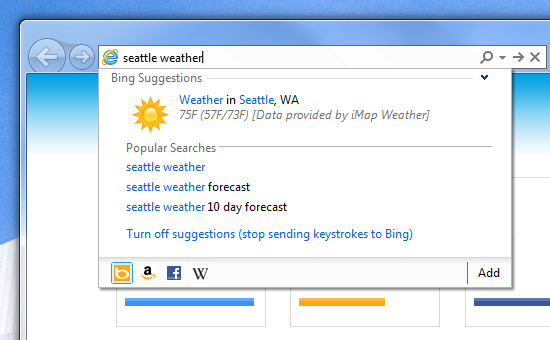
The address bar also gets an overhaul and now gives inline search as you type results.
Also coming soon is Firefox 4 which has recently hit release candidate and will be finalized in the coming months. As you can see from the graph above, Firefox 3 is really slow.
The more cautious out there might want to wait a few weeks to update so that any major early bugs and site incompatibilities can be worked out. And before you tell me that you don’t care because you use Chrome or Safari, that’s cool, but you should upgrade anyway there are some sites that still refuse to work with those browsers.




 Ok, so you go to a tasting at a wine shop. Now what? First of all, these are very casual affairs. You won’t find people putting on airs, but you often see people who know their shit about wine there. Most stores will give you a small plastic cup to taste the wine. Frankly, this is my pet peeve as I hate drinking good wine out of a plastic cup. When I do tastings at a wine shop, I bring 40 or so glasses, real glasses to taste the wine. It is not unheard of for customers to pull out their own tasting glass. Here is a picture of my tasting glass that I carry with me. I personally like it because of the lack of stem which can break when lugged about.