By Lady_E with assistance from Kenneth Gibson
Despite his bizarre claims in an interview with ABCNews’ Christiane Amanpour, Gaddafi’s crackdown on opposition forces intensified over the weekend with Special Forces, regular Army forces and fighter jets striking opposition targets. Meanwhile, opposition forces announced the formation of the National Libyan Council and selected former justice minister Mustafa Mohamed Abdel Jalil is to lead the initiative. The Council will coordinate attempts to liberate Tripoli and other Libyan areas still under Gaddafi’s control. On Sunday, Sens. McCain and Lieberman called on the US government to recognize and arm the provisional opposition government. Over the weekend and through last night, opposition forces fought fierce battles against pro-Gaddafi forces to maintain their hold on ‘liberated’ areas, but neither side appears to have gained a clear military advantage. Opposition forces repelled sustained pro-Gaddafi assaults on the opposition-held towns of Zawiyah and Misrata, but attempts to reach Tripoli did not materialize and it remains under Gaddafi’s control.
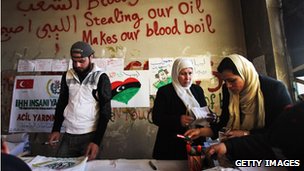
Beyond the military assaults, Libyan civilians trapped by the fighting are facing food and medical supply shortages. Over the weekend, The International Committee of the Red Cross (ICRC) entered Eastern Libya, including opposition held Benghazi, and is now providing medical assistance. The ICRC reports 256 killed and 2,000 people wounded in Benghazi. On Monday, French Prime Minister, François Fillon, announced that France is also sending two planes carrying doctors, nurses, medications and medical equipment to Benghazi. The planes are scheduled to leave this morning. However, due to the security situation, aid is not reaching western parts of Libya. According to Valerie Amos, the UN humanitarian chief, the security situation around Tripoli remains too dangerous for international aid agencies to assess the need for medicine, food and other supplies in the west. The ICRC has also not been able to access Western Libya and Al Jazeera reports this morning that Gaddafi’s regime may be purposefully blocking food supplies to Western towns as a means of undermining opposition control.
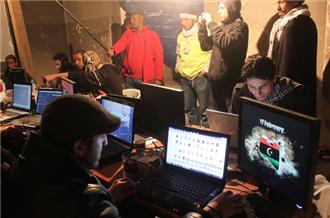
For Libyans and foreign nationals who have been able to flee the country, refugee support remains limited. Sybella Wilkes, spokeswoman for the United Nations High Commissioner for Refugees, announced that more than 140,000 refugees have fled into neighboring countries, estimating that up to 75,000 refugees had already crossed into Tunisia from Libya and 69,000 others had crossed from eastern Libya into Egypt. Over the weekend, witnesses and news reports documented Tunisian guards repeatedly opening fire on refugees attempting to enter and refugees being beaten by guards. Once through the border, the refugee situation remains precarious. The Tunisian camp can accommodate about 10,000 people. “The resources are being drawn down as quickly as we can pump them in,” Ms. Wilkes said in a telephone interview. Relief workers have said they are concerned about sanitation in the camp and supplies of drinking water. In Geneva, Secretary of State Clinton announced the Obama Administration has set aside $10 million for emergency humanitarian relief through the U.S. Agency for International Development and that two teams of USAID experts are being sent to Libya’s borders to assess the refugee crisis and organize the delivery of aid.
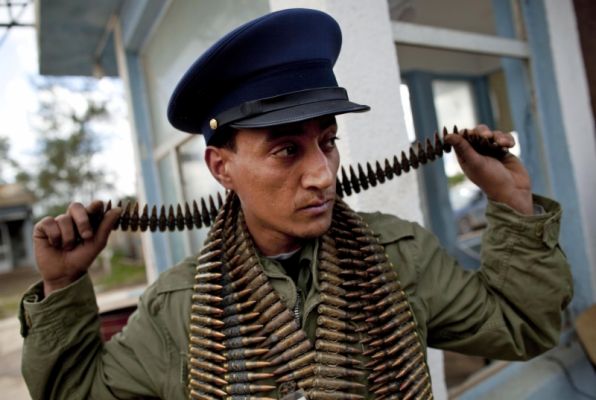
More than two weeks after the uprising began the International community continues to increase pressure on the Gaddafi regime though military intervention but the imposition of a no fly zone remains unlikely at this point. Over the weekend, acting on President Obama’s Executive Order, the US Treasury Department froze $30 billion in Libyan government assets. The European Union imposed new sanctions, including an arms and police equipment sales embargo and a visa ban for Libyan officials. On Saturday the Security Council met for a second time and adopted Resolution 1970 under its Chapter VII, Article 41 authority which includes 1) an ICC referral, 2) an arms embargo, 3) an asset freeze and 4) a travel ban (Note: the Resolution link provides summaries of the Security Council member statements on the Resolution. Importantly, Ibrahim Dabbashi, the Deputy Permanent Delegate, represented the Libyan delegation).
Despite repeated pleas from the Libyan UN delegation, human rights groups and some US elected officials, the UN Security Council did not include imposing a no fly zone to prevent Gaddafi from bombing civilians by air. Today, Russian Foreign Minister Sergey Lavrov ruled out Russian support for a no fly zone. Russia is a permanent member of the UN Security Council and has veto authority. NATO could impose and enforce a no fly zone but has stated that any military interventions would have to be UN authorized.
For additional information and ongoing updates:
ICRC Resource Page: http://www.icrc.org/eng/resources/index.jsp
For up to the minute updates, links to on the ground reporting and a twitter live feed from the Region, visit the The New York Time’s Lede Blog (twitter feed on the right): http://thelede.blogs.nytimes.com/2011/03/01/latest-updates-on-libyas-revolt-and-mideast-protests-4/?hp
Al Jazeera English live stream: http://english.aljazeera.net/watch_now/
For those having problems with the Al Jazeera live stream (maybe it’s just me), sign up for LiveStation (it’s free!) and you can watch any Al Jazeera channel: http://www.livestation.com/
UN News Centre: http://www.un.org/news/
Images via BBC, Guardian, Al Jazeera and Newsday
Have a favorite news source we are missing? Put a link in the comments!



 1886: Oskar Kokoschka: When I was in art school, we had a thing wherein we’d go behind someone, push them lightly on the shoulders, not enough to make them fall down, but enough to scare them, and scream Oskar Kokoschka’s name. It was an act of absurdism in the name of the master of German Expressionism and the idol of myself and several of my friends. The painter, poet and playwright was originally told that he was mentally unstable after being injured in World War One, but aren’t all the greats? I know that I’m pretty mentally unstable. Who wants to be stable? Perhaps its my idolatry of Kokoschka that has led to my allowing myself this instability. Anyways, the Nazis deemed him and his work degenerative, so he escaped to Prague, until the Czech began to mobilize for an invasion from Germany and he escaped to the United Kingom. His style was very nervous, but filled with great motion and intrigue and his play is considered the first Expressionist drama. The individualism displayed by himself and Max Beckmann created one of the greatest offshoots of the Modern Art movement, though Kokoschka saw himself as a footnote in the annals of art history towards the end of his life which made him bitter. Here’s an example of his work: The Red Egg, 1941, currently in Prague’s Narodni Gallery:
 1987: Ke¢ha: That girl who always looks really dirty and sings about brushing her teeth in the morning with a bottle of Jack Daniels because she’s a complete alcoholic turns 24 today! Ke¢ha is a terrible idol, mainly because while she’s had great success, she’s not particularly talented. I like Ke¢ha when I’m driving and not wanting to listen to WRCJ or WOMC, but that’s about it. There’s no substance. Still, she has more money than we could dream of, but hey, I like her better than Gaga so there’s that.
 Ashlee Simpson’s baby naming idol was kidnapped as a kid by the King of England as a pledge for the continued good faith of Gryffydd’s father Llywelyn the Great. Griffid. Gryefehd. Gryffindor.
  1980: Wilhelmina Cooper: An icon amongst models and the idol of every aspiring girl, Wilhelmina Cooper, founder of Wilhelmina Models, and the woman with the most Vogue covers: 28. She appeared on 255 covers during her career, launched Naomi Sims, the first black supermodel and was portrayed by Faye Dunaway in the movie Gia about another model Wilhelmina’s agency launched to stardom, Gia Carangi who later died of AIDS.
 1984: Jackie Coogan: A comedic idol! Jackie Coogan was a stah! A child stah! With all the child stah problems like having his parents steal his earnings. Naturally, he sued them, got very little of the money he earned and got a bill named after him that requires 15% of child star earnings to be placed into a trust. He’s best known as Uncle Fester on The Addams Family, but he was also Oliver Twist.


 1824: Blondin: Humpty Dumpty sat on a wall. Humpty Dumpty had a great fall. All the King’s horses and all the King’s men couldn’t put Humpty together again. This French tightrope walker didn’t die from a fall, but he did have a fall that ended with the death of two people. It’s such a shame when the good intentions of entertainment lead to death. In 1861, while performing 50 feet above the ground, the rope he was on broke, causing the scaffolding to fall. Blondin was not injured, but two workers who were on the scaffolding fell to their deaths. An investigation occurred in which no fault was put onto Blondin or his manager. However, the judge said the rope maker had a lot to answer for. The man who ran the venue where the incident occurred vowed never to have a spectacle of that sort ever again, yet, Blondin was back the next year doing a tightrope walk 100 feet above the ground even though there was a bench warrant against him and his manager for not appearing at a trial in regards to the earlier, deadly incident as they were touring in America at that particular time. Blondin enjoyed a successful career until his death some thirty years later.


 1891: George Hearst: Georgie Boy had good intentions. He wanted the American Dream™ and he lived the American Dream™. He became a successful miner and investor and became a United States senator: The American Dream™. He more than provided for his family including, and this is where his good intentions took a turn for the worse, his son William Randolph who became a newspaperman and championed yellow journalism and that’s why we have stuff like the NY Post. Ugh. Hate you George, but mainly because we blame you for bad puns in headlines. You yourself are pretty awesome and a good role model for all us prospectors headed towards California, which would be us! Announcement: We’re moving to California to find gold!
 1965: Emile Buisson: The French! Always surrendering! Well, this one had terrible intentions and he didn’t so much surrender as he was caught, but, then again, he didn’t kill them all when they closed in. He surrendered himself. Just like the French are wont to do. Anyways, Emily was a French gangster who killed a lot of people, and by a lot of people, we mean a lot of people. Like, more than thirty people. That’s a lot of people! What bad things can happen from good, we mean, bad intentions.