News

1889 posts

Gov. Walker: Ending Collective Bargaining Has Nothing To Do With The Budget

Governor Scott Walker has finally admitted that busting the Wisconsin public employee’s unions has nothing to do with the fiscal health of the state.

Can somebody give this guy the "Santorum" treatment on Urban Dictionary?

Wisconsin only requires a quorum to pass fiscally-related bills. So Gov. Walker has split his union busting bill in two and the Wisconsin senate Republicans are getting ready to pass the union busting bill without the senate Democrats.

I’m afraid the Democrats may not win this one. It is almost impossible to win when you are dealing with people who have no concept of shame or honor.

Link to full story on TPM

UPDATE 7:50pm: Bill passed 18-1 in the Senate. Now it moves to the State Assembly. In addition to forbidding collective bargaining for the public unions, the bill also includes requirements for state employees to contribute 5% of their income to their pensions, 12% to their health care. It also requires school district and municipal employees to contribute 5% to their pensions.

A 17% hit to the paychecks of thousands of people doesn’t sound non-fiscal to me.

Top photo Flickr.

Pits are the pits, or not?

Three summers ago, I was mauled by a pit bull. He tried, unsuccessfully, to attack Nanook, our samoyed/chow mix. She came away with just a bruise and wounded pride, while I spent an entire day in the emergency room awaiting my 12 stitches and staring, in awe, at the three inch gaping hole on my thigh. I could actually see the fat in my leg! The dog who did the damage was a pit mix rescued from Katrina. 2 weeks after the incident, he was euthanized. My heart ached for him. You see, I don’t blame him, I blame the owner. His irresponsibility and outright ignorance of the breed caused one more unnecessary death in the approximately 970,000 pit bull euthanizations in America’s shelters in 2008. Both pure bred and mix breed pits account for 58% of all dogs put down in this country each year. By far, most of them end up at the pound because of abuse, neglect, and owners who can no longer care for them, not because of their aggressive nature.

This overwhelming statistic is almost too painful for me to consider. Although most who were in my situation would automatically take a stand against this breed, I’m torn. Torn because we have a pit mix in our home.

Meet Ugo. The love of my life. When people ask me what breed he is, I start to go down the list; boxer, German shorthair pointer, dane, and…. pit bull. And then “the look” rears its ugly head. You know, that look that says “well, he WAS cute, but now…um, gotta go!”. Some people literally back away so quickly, they trip. Others cross the street when they see him, or ask if he bites, from a block away. Truthfully, when I look at him, I can’t see the scary. He is the most gentle, loving, submissive dog I’ve ever met. His best friends are, usually, dogs a tenth his size and twice his age. With all other K9’s, he’s the awkward kid on the playground who REALLY wants to play with others, but just doesn’t know how. His blind, 11 year old “sister” Nanook, loves him like no other which is no small feat considering she is aloof, at best, with everyone else. I often wonder why not everyone is as enamored of Ugo as we are.

Then, I remember what those people see when they look at him. They see aggression, attitude and a thirst for blood. In short, they see a killing machine. They see a breed that began because of a human penchant for fighting. Not only were these dogs bred for fighting each other, but also for bull and bear baiting. Although, the latter has mostly vanished, the former is flourishing. Every year, 250,000 pit bulls are maimed or killed in dog fights (from HSUS) that earn humans millions of dollars, but are a death sentence for those unlucky enough to be on four legs.

According to Adam Goldfarb, director of the pets at risk program for the Humane Society of the United States, “Dogs are products of their environment. Dangerous dogs are not born, they are created.” Therefore, education seems to be the best, maybe the ONLY solution to end dog fighting and bring the pit bull’s reputation back to reality.

According the the ASPCA, rottweilers and pits (pure and mixed breed) account for a “majority” of the dog attacks in this country, but ANY dog is capable of sinking his teeth into your leg. Here are some statistics courtesy of the American Humane Society:

  • An estimated 4.7 million dog bites occur in the U.S. each year.
  • Approximately 92% of fatal dog attacks involved male dogs, 94% of which were not neutered.
  • Approximately 25% of fatal dog attacks involved chained dogs
  • Approximately two-thirds of bites occurred on or near the victim’s property, and most victims knew the dog.
  • At least 25 different breeds of dogs have been involved in the 238 dog-bite-related fatalities in the U.S.
  • Approximately 58% of human deaths involved unrestrained dogs on their owners’ property

It seems, from these statistics, that certain rules are a MUST (for ANY dog owner):

  • Spay/neuter your dog. This will significantly cut down on their aggression and make them less territorial.
  • When using your dog for security, do not use a chain. This makes them more territorial and, therefore, more likely to strike.  Use a retractable, tethered lead that allows them to move about more freely.
  • Just because you are familiar with a dog, does not mean he/she will remember you. Always, re-introduce yourself by letting the dog smell you and remember to approach with your hand below the chin, not from above.
  • Most importantly, ANY dog is capable of biting you. Just because it’s a pocket pet under 20 lbs, doesn’t mean it has no teeth!


In no way do I expect one article to change decades of stereotype and skepticism. All I am hoping for is that my words will help shift the “blame” away from the dog and towards a solution. A solution that provides us with the tools and figures to educate each other about the proper way to care for our K9 companions.

Next time you see what you think is a pit bull, stop and ask. The owners will be grateful for the chance to crush the myth and the dog might turn out to be your friend for life….

Here are some great links to further the cause. They make for very interesting reading:
NPR
The lone Chicago “dog officer” GRAPHIC
Pit bull Heroes

McDonald’s No Longer Dominating Fast Food Presence

Have you noticed everywhere you look there’s a Subway sandwich shop? Like literally on every street corner, and in every shopping center — there are one, now two, or perhaps three Subway eateries in a single mile radius? Yes? Well, that’s not just a coincidence.

Has the burger giant been dethroned? Well, yes and no.

Subway has now globally surpassed McDonald’s in store presence, a feat heretofore not accomplished by any other fast food company. The sandwich chain opened 33,749 restaurants worldwide at the end of last year, to McDonald’s 32,737 stores. That’s a lot of five-dollar foot longs.


What does this say about the expectation of our eating habits? Certainly we all recall recent marketing campaigns that tout Subway sandwiches as an alternative to typical greasy fast food choices. Their liberal use of words like “eat fresh,” is used often to combat the growing concerns regarding the copious trans fats and high caloric counts of their fast food counterparts.

Even our friend “Jared the Subway Guy” still appears every now and again to show us that he’s kept the weight off, even though we are well aware that if you eat excessively at any fast food restaurant any and all attempts will be outweighed by sheer input of calories. A bit of slight of hand on the part of Subway? Perhaps. But the nutritional data is solid. It’s true that the sandwich giant does offer options that in moderation are healthier than the typical fast food fare.

For instance, Subway’s “Fresh Fit” meal option includes sliced turkey, lean roast beef, or Black Forest ham, with fresh veggies, (without cheese, mayo, or any of the other sauce choices), on baked whole grain bread, and a choice of apples, yogurt, or baked chips, and a water. Average total calories: 355 to 450. Conversely, McDonald’s flagship Big Mac Meal, which includes a Big Mac, medium french fries, and a large soda, is a staggering 1230 calories. In addition, the newer Angus Third Pounder burger tips the scales at 720 to 860 calories (depending on options) alone.


This is not to say that McDonald’s, in a demonstrated mea culpa, hasn’t stepped up their game to offer healthier options like salads, wraps, fresh fruit, yogurt, smoothies, and other lesser fatty foods, but realistically these fewer options are not what’s driving consumers to eat their offerings. And it shows in their revenue.

While Subway is dominating store numbers, McDonald’s is still the overall revenue champ. The company reported $24 billion in revenue for its last fiscal year. Subway generated roughly $15.2 billion, according to a report by the Wall Street Journal.


McDonald’s on Tuesday said global sales at established restaurants in February rose 3.9 percent, as strong sales in Europe helped offset a U.S. market that was hit by high unemployment and rising gasoline prices. In addition, February sales were up 2.7 percent here in the United States, helped by strong demand for its McCafe beverages, reports the Associated Press.

So apparently to offset sales lost nationally because people were out of work and couldn’t afford gasoline to get to a McDonald’s drive thru, the company is relieved that some people were able to beat the odds and drag themselves in the stores for McDonald’s new line of coffee sundaes.

Obviously this is the next obstacle Subway has to face in its efforts for complete fast food domination. Sadly, I think there are probably fewer actual “winners” here than both companies would like to acknowledge.

Exclusive: Interview with Boycotting Indiana Rep. Terri Austin

Today, Crasstalk is thrilled to present a conversation with Indiana Democratic Representative Terri Austin (IN-37).  Rep. Austin was one of two Democratic legislators who remained at the Statehouse to object to any legislative business occurring without a quorum.  A leading voice in education, mass transit and transportation, Rep. Austin has spent the last two weeks traveling back and forth from the Indiana Statehouse to Urbana, Illinois, where the remaining Democratic caucus members have been since the standoff began.

As they enter their third week of boycotting the Indiana House of Representatives, Indiana Democratic legislators are facing enormous pressure from all sides.  On one side, there are calls for them to come to the Legislature and go back to work.  On the other, countless Hoosier workers and teachers who have rallied day after day, numbering in the thousands each time, to show their support for the Democrats’ stand.  What is happening in Indiana is different than what is occurring in Ohio and Wisconsin. However, there are also common themes threaded through each states’ stand off.  For many, the events in Indiana and across the country represent no less than a battle for the future of the American working class.  Are unions a thing of the past?  Do public employees deserve collective bargaining?  These are just a few of the questions raised by this situation.

Indiana Democrats released the following statement about the boycott.

On Tuesday, February 22, 2011, House Democrats used their constitutional obligation to prevent quorum on the House floor to stop a radical agenda that was a direct attack on working Hoosiers and our public schools. We left for Illinois to give the thousands of Hoosier workers, teachers, and families a real voice at the State House. Our decision was to send a message to Republicans that we were serious about our concerns. Some say we should come back and do our job. We believe that fighting on behalf of thousands of Hoosier students, workers, and families is our job. To sit in the chamber and simply vote no was not enough.

Source: Indiana State Legislature

Before focusing on the substance of why Democratic legislators left the state, I want to ask you about the tactic of walking out or boycotting the legislature.  Some have suggested that this is not an appropriate way for a minority party to block legislation.  How do you respond to this criticism?

Rep. Austin:

I have great respect for our legislative institution and its rules.  The tactic of quorum-busting—causing a quorum to be prevented from meeting—has been used in legislative bodies by minorities seeking to block the adoption of some measure they oppose. Quorum-busting has been used for centuries. For instance, during his time in the state legislature, Abraham Lincoln, leapt out of a first story window (the doors of the Capitol had been locked to prevent legislators from fleeing) in a failed attempt to prevent a quorum from being present.
To remain out of the House chamber should be used rarely and done only after careful consideration.  We know that Speaker Bosma and other House Republicans understand this, because when in the minority, they used this Constitutionally-granted ability in 2001 and 2004.

Both Republican and Democratic members have participated in walkouts that have stopped legislative action.  However, in the recent past, members have not left the state.  Why did the Democrats feel they needed to leave the state?

Rep. Austin:

The decision to leave the state was made after careful deliberation.  There was significant concern that the Speaker of the House or the Governor would use the powers of arrest to compel attendance.  The only way to ensure that this would not happen was to relocate to a region where the powers of arrest were not recognized.  It also gave us uninterrupted time to review, discuss and debate the various pieces of legislation we were concerned about and to develop proposed amendments to the bills.  We believe that the legislature works best when a spirit of bipartisanship and compromise is present.

Indiana House members initially left the state to stop Right to Work legislation from passing.  Why is the Democratic Caucus opposed to RtW?

Rep. Austin:

The decision to break a quorum was not just about Right To Work.  Over the last couple of weeks the barrage of controversial and critical bills, put on the calendar at the last minute, hampered the ability of legislators and the public to understand the details of these bills much less consider their long-term consequences.   Let me give you an example of what I mean.

The RTW bill was scheduled on the very last morning for committee hearings.  The hearing was held in less than ideal conditions.  There were hundreds of people who traveled to the statehouse to testify regarding the bill.  Many could not even hear the testimony because the hearing room only held about 50 people.  Others were forced to stand outside in the hallway or throughout the building.  92 people who signed up to testify were not given an opportunity to testify.

It is important to note that there was conflicting testimony on the positive impact of RtW legislation in other states.  Dr. Gordon Lafer, an Associate Professor at the University of Oregon indicated that all of the most recent scientific studies show that RTW has zero impact on job growth.  In fact, only one state, Oklahoma, has adopted Right To Work over the past 25 years.  One problem with basing public policy decisions on what happened in 1970 and 1980 is that we live in a fundamentally different economy today.

Something this important should not be determined in a 90 minute committee hearing where Hoosiers were denied an opportunity to hear the testimony or offer their thoughts and opinions as citizens.

I think you can see from this example and news reports of the session that legislators and the public were not fully educated on several bills that were moving like a runaway freight train.  Although the “Right to Work” (RTW) bill has been depicted as the primary reason for the “time out”, it was a whole list of concerns.  This time out has given the public and legislators the time to learn about the content of these bills.  As can be noted by the thousands of citizens who have demonstrated at the statehouse and rallied in their communities, the public is becoming more aware of these issues, and they are speaking up.  The focus of this time-out should not be the absence of the House members but the potentially damaging impact of these bills.

Almost immediately after the Democrats left, Republican leaders pledged not to advance the RTW legislation. But, the Democrats did not come back. Why?

Indiana State Democrats


Rep. Austin:

As explained above, there were other pieces of legislation that would have had a drastic impact on Hoosier families and children attending public schools.  Democrats’ decision to remain out of the statehouse allows time for the bills to be fully examined, amendments developed, the public to be informed and their voices to be heard.  The Democrats have consistently expressed a desire to work in a spirit of compromise and negotiation.  Efforts to do just that have been rebuked and refused by the House leadership.  Republicans have said there is no negotiating, their agenda will pass.  Their rhetoric and unwillingness to compromise have forced us to fight from Illinois – our only means left to defend the jobs of working people in Indiana and the education of Hoosier children.

This session began with a great hope of working with our colleagues across the aisle to develop a plan for job creation, move our public schools to the front of the class and draft a fiscally responsible state budget.  Speaker Bosma started this session saying it was a “new day” in the House chamber, and he was going to seek a new level of bi-partisanship.   Unfortunately, we’ve seen the complete opposite.  This session has seen only 29 percent of the votes be cast in a bipartisan manner.  Normally, 80-90 percent of the votes in a session are bipartisan.

Please understand that House Democrats did not cross our arms and say “no” to everything that was proposed by our Republican colleagues.  Even if we disagreed on a bill, positive and compromising alternatives were offered to improve and/or moderate the consequences if we felt they were harmful to our districts and our constituents.   Most times those ideas, offered in good faith, were summarily dismissed   Our kids’ education and our families’ wages shouldn’t be the victim of partisanship.  Hoosier families deserve better than that.

Source: Indiana House Democrats Fighting for Families

Do Democrats have a list of specific bills that they want to negotiate on before agreeing to come back?  If so, can you briefly explain what they are?

Rep. Austin:

There is no list of “demands” as has been suggested.  However, several bills impacting public education and the future of the middle class in Indiana are of great concern.  HB 1003 creates a voucher program that sends public tax dollars to private schools for a select number of children.  HB 1479 allows for the immediate state takeover of 212 schools and gives the State Board of Education the authority to appoint a for-profit management company to run the school.  Other legislation impacts individuals’ rights to voluntarily have association dues or fees paid from their paycheck.  Others greatly restrict employees’ ability to work with management regarding areas of mutual concern.  Many of the bills will drive down Hoosier wages and benefits.  Hoosiers already earn only 85 cents on the dollar as compared to the U.S. average.  The Republican proposals have been proven in other states to lower wages by $5,500 a year on average.

These are just some of the bills that many legislators feel will be harmful to their communities.

Are the Democrats asking for specific legislative changes to be agreed to before you will come back or are you asking for an opportunity through open debate and proposed amendments to change them once you do come back?

Rep. Austin:

The Democrats are willing to work with everyone in a spirit of compromise.  Negotiations are never successful when one party or the other draws a line in the sand.  It is important to keep the lines of communication open and for both parties to come to the table with respect and a willingness to listen.

The Crasstalk community includes people from all 50 states.  It seems that the same legislation Indiana Democrats are objecting to is also being proposed in other states, notably Wisconsin and Ohio.  Are Democratic legislators talking across states and coming up with a larger strategy to counteract what seems to be a nationwide Republican effort?

Rep. Austin:

I am not aware that talks with other Democratic legislators are going on to develop a strategy.  I do know that the communications that have taken place are more about supporting each other’s efforts and comparing different pieces of legislation across state lines.

Are you personally concerned about any political fallout from the Democrats’ boycott? Why or why not?

Source: Indiana House Democrats Fighting for Families

Rep. Austin:

At some point, you have to stand up for what you believe in, regardless of the consequences.  I was elected by the people of the district to try and make their lives better and to be their voice in state government.  Many of the pieces of legislation would not have a positive impact on the families and children that I represent.  I believe that Hoosier families are worth fighting for.

Last question. Many people who will read this are not Hoosiers and may have never been to Indiana. As an elected representative of Hoosier residents, what is the one thing you would most like them to know about Indiana?

Rep. Austin:

It’s a wonderful place to grow up and to work.  Yes, we face some challenges but also we have many positives that make us attractive to young people, families and entrepreneurs.  I had the opportunity to travel to Taiwan and Japan several years ago as a part of a state delegation.  When we met with business leaders who talked about why they brought their companies to Indiana, they indicated two things that set us apart: our Hoosier work ethic and the excellent education their children received.  Unfortunately, some leaders forget to tell people the things they are doing well before they tell them why we need to do things differently.

For More Information

Indiana House Democrats Fighting for Hoosier Families Facebook page.

The Hoosier Stand.

Just SIT (Support Indiana Teachers) Facebook page.


Palin: Africa Rumor a Lie

In an interview with the BBC out yesterday, the former half-term Governor of Alaska, failed Vice Presidential Candidate and mother of the most embarrassing Dancing With The Stars contestant ever, remarked that the rumor that she did not know Africa was a continent (and not a country) was a fabrication by “jerk” staffers.

Next, she’ll be suing Tina Fey for impersonating her during the infamous Katie Couric interview.

Sarah, wouldn’t it be simpler to just read a book once in a while?

Link: BBC.

The Other “Mother’s Day”

Correction: Though the observations below were correct at the time of writing, they have now been rendered somewhat moot as Jezebel acknowledged International Women’s Day in an article posted at 12:35 P.M. My apologies.

In what must have surely been a lack of judgment borne of caffeine deficiency, I checked Jezebel for the first time in months this morning to see if they’d have a post about the 100th anniversary of International Women’s Day, seeing as how they are supposedly a feminist blog. The sound of crickets was as palpable as it was predictable, though they did have some lovely posts about Lily Allen’s eating disorder and how sharing photos on Facebook affects your self-image.

But I’m not here to compare Western feminism to the late Roman Empire or lament its decadent decline into a trendy and degenerate blogosphere variety that is devoid of any sense of history or intellectual underpinnings and relies mainly on shallow sarcasm and a fixation on policing the most vapid aspects of our culture as an attempt to justify and intellectualize one’s interest in them. Because today is not about that. Today is about the achievements of women worldwide, and the serious struggles many of them still face.

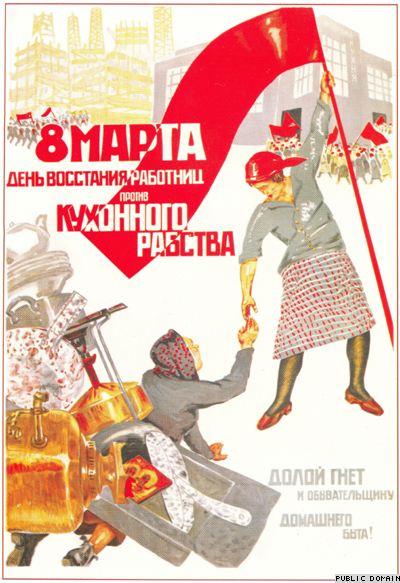
To say it’s ironic that many in the United States have never heard of this holiday would be an understatement. For although the first official celebration of International Working Women’s Day took place in 1911 across several German-speaking nations, its origins lie in the National Women’s Day organized and celebrated by the Socialist Party of America in 1909. Rosalind Rosenberg, a history professor at Barnard College traces it back even earlier, to a protest held on March 8, 1908 by 15,000 female garment workers in New York City’s Lower East Side. It was in 1910, at an international women’s conference in Copenhagen, that the day acquired its international character.

As the holiday gained recognition and popularity across Eastern Europe, particularly in the newly established USSR, it quickly lost ground in the United States, first with the unpopularity of the Socialist Party’s opposition to US participation in World War I, and later when the Red Scare made the word “Socialism” into anathema. But even in the Soviet Union, where I grew up, the socialist character of “8 Marta” was never in the forefront – at least no more than it was in any of our other holidays. Rather, we mainly celebrated it as an all-around “Women’s Day” – Valentine’s Day and Mother’s Day rolled into one. But we also remembered the unimaginable sacrifices and hardships our mothers and grandmothers had endured during World War II and their invaluable contributions to our victory.

"Day of Women's Uprising Against Kitchen Slavery"

International Women’s Day was not formally recognized in the United States until it was established by the UN in the 1970’s, and even since then, it has barely registered on the radar. However, on the eve of today’s centennial celebration, President Obama not only called on Americans to observe the day, but proclaimed the entire month of March to be Women’s History Month. On the same day, Secretary of State Clinton launched the “100 Women Initiative”, gathering 100 women from 92 countries for a three-week professional exchange program in the US.

It is as important today as on any other day to take note of the injustices that still keep one-half of the world’s population in a subordinate state. But in light of recent events in Wisconsin and Ohio, I think it is also particularly relevant to remember this holiday’s origins as International Working Women’s Day, and to stand against the obstacles that workers – especially female workers – face in their struggles for a more just and equal society.

Now if you’ll excuse me, I’ve gotta go call my mom, and then my grandma.

Late Bloomer / The Mantel

“Well, I’ve got him.  I’m just not sure what to do with him.”  Tom set his wineglass down on the patio table with a click and condensation splashed the hot glass surface, and the phone was slick in his hand.   The July sun blasted just two feet of tile along the length of the covered terrace, but it felt like an African veldt.  Loki, his fluffy Maine Coon tabby, lounged in deflated defeat in the shade of a potted clematis, opening one green eye from time to time in disapproval.

“Just have fun, boodles, you deserve it.” Thus spake Bill, ever the sage friend and wise counselor.  Too bad he was wrong 90% of the time.  Tom looked at the phone with annoyance, and the heat was only part of it.

“I am 35 years old and I have had enough fun.” he began.

As he often did, Bill interrupted.  “No, you haven’t.  You were all repressed in the ‘80s and ‘90s because you were trying to be Mr. Perfectpants for your wacky WASPy parents.  You became a serial monogamist.” This last dripped contempt, and he may as well have called Tom a serial killer.

“That’s what I want!  I’ve got all the casual stuff out of my system.  I’m not judging, I just want…”

“You want to be Samantha from Bewitched, is what you want, with your sweet New England-y house on Long Island Sound and your Wedgwood china and your well-maintained car and dinner parties and planting geraniums.  Except instead of Darrin you want a massive linebacker who talks dirty in bed and likes museums.”

Now this was truly annoying, because this was one of the 10% of times that Bill was right.

Taking a gulp of Pinot Grigio, Tom said. “Yes.  Something like that.  Is that so wrong?”

Bill chuckled.  “No, boodles.  But I think your cop with the – how did you say?  Sparkling eyes?  Anyway, he might or might not be the ticket.  Soooo… find out.  But don’t make it so damn serious.”

Pushing his very serious glasses up on his nose, Tom considered.  Slowly, he told Bill: “There’s some things that are… not right.  His clothes are dismal.  His apartment could be nice, but there’s dust bunnies in there that could eat me.  He smokes – not a lot, and he’s considerate, but still.”  Tom unbuttoned his linen shirt and fanned himself with Vanity Fair.  It helped a little.

He could almost see Bill’s eyebrow rise through the phone.  “Let’s recap that last date, k?  Quote: ‘He grabbed my hands and pinned me to the sofa and we made out like it was high school and he’s SO BIG and SO HOT and then he did that thing with his 5 o’clock shadow and my neck that drives me wild.’  Not a dust bunny to be seen.  As I recall, his shirt was off too, so you didn’t have to look at it.  Kohl’s, I bet, or some Big’nTall outlet, cast aside in the dust bunnies while you got your groove on.”

“I’m sorry I told you that.  In any case, it’s a long way from there to geraniums by the sea.”

“I want to meet him.”  Bill announced.

“No way.  You’ll scare him off.”

“He’s been shot at and had large buildings almost fall on him; he can handle me.”

“I think he’d prefer being shot at.  I know I would.”  Grabbing his wineglass, Tom slid inside to the cool air conditioning, padded to the kitchen and poured a refill.  “I can deal with this. I think.”

“Well, you should just enjoy the moment more, is all I’m saying.” Bill was back in sagacious oracle mode again, and it occurred to Tom that his description of the man in question must have piqued some curiosity.  He ducked outside again through the terrace door and parked himself in the yellow Adirondack chair he called The Throne.

A noise from the street below drew his attention, and he stood, leaning over the windowboxes bursting with begonias and mini roses.  It was a failing muffler, and it belonged to a crumbling white Jetta, which belonged to a very large man.  He got out and stretched, displaying wide shoulders straining an NYPD t-shirt which was damp in a few places, then ran a hand through his black velvety crewcut.  Sweat glinted from his brow and forearms.  He was magnificent.  Baggy shorts did little to hide tree-trunk legs and while his midsection wasn’t cut or anything, he was undeniably in great shape.

“Bill?  I think I have to go.” Tom said.

“Later, dollface.”

Shading his eyes against the sun, Tom watched as the big man opened the rear door of the Jetta and carefully pulled out a clay pot with bright pink and white flowers held above glossy green rounded leaves.  When he stood up, he seemed to feel Tom’s eyes on him and grinned.

Geraniums, Tom thought as he waved.  His name is Mike, and he brought me geraniums.

…..

Carefully, the old man took the device from a drawer in the gleaming kitchen and headed for the living room.  The Kid had given it to him for Christmas, and it had proven most handy.  He imagined that The Kid would be all frantic at seeing him up and about with no one else in the room and there would be a lecture about broken hips and pigheadedness.  That was all right.  He had little use for sleep these days.

The french doors to the patio were open and carried the scent of roses, fresh cut grass and geraniums into the room, with a little hint of the ocean.  The warmth was soothing to the old man’s bones and he smiled crookedly as he shuffled over to the mantel.

The first picture on the left was of him and The One.  The old man found it easier to think of him that way, rather than be bothered with names that jumbled themselves up in his head.  They were in a nightclub in the photo, and his arm was looped around The One’s shoulder as colored lights played over both of them.  He turned on the gizmo, which whirred and removed any dust from the braided silver frame.  There had been a kiss that night, and it had tasted of green apples from the drinks they had.

The next picture was in a heavy antique frame that required polishing, which the old man’s arthritic fingers couldn’t manage anymore.  But the gizmo whirred again and the glass sparkled over him and The One in tuxedos on the steps of The Cathedral Of The Incarnation in Garden City.  That had been quite a day.

The third picture was in an enamel frame that said Steven’s First Christmas, and showed the old man, then younger, grinning tightly at the camera over the shoulder of The Kid, a sullen teenager.  The One was giving both of them what was called at that time the side-eye.  It was, in hindsight, a hilarious shot, and the old man grinned toothlessly as the gadget polished it up.

A sleek, modern silver frame was next.  There was The Kid in graduation robes standing next to a young lady with glossy waves of black hair and an insouciant grin.  Julia.  Her name came to him unbidden.  The Kid was grinning too, all the way to his eyes, and his cap was tilted at a jaunty angle.  After a short hum, the silver gleamed around them.

The last picture was in a frame of popsicle sticks with a scallop shell glued to each corner.  It showed the old man and The One sitting on a beach on either side of a girl of about five, all with their backs to the camera.  An unexpected wave had come in and they were each reacting with varying degrees of surprise, and the girl’s shiny black hair was tumbling out of its ponytail.

A hum removed any dust, and this completed the old man’s task.

“Whatcha doin’?” said The One, padding down the stairs.  “You really should be more careful.”

The old man smiled.  In fact, this little chore was kind of exhausting and he headed for the sofa.

“Minding my business.” he said to The One, in a tone that suggested that he do the same.  He placed The Kid’s gadget on the glass-topped end table carefully, then sat.

The One plopped down on the sofa next to him, and both men regarded the garden outside.  Slowly, the old man turned to The One.  There was more than a trace of a square, stubborn jaw and his eyes were alight with mischief and humor.

“Mike,” said Tom, more clearly than he’d spoken in months,  “Can you get me a scissor?  I want to bring some geraniums in.”

“It’s  gonna cost you a kiss.”

“I may be ninety-whatever, but I remember how to do that.”

Life, Death and Violence: Dream On

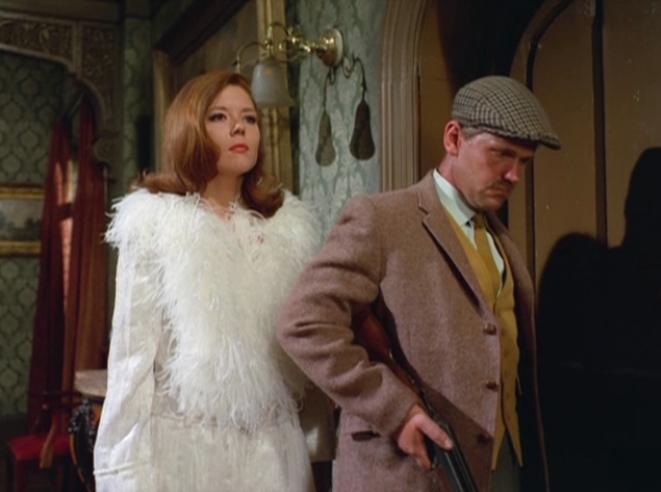
From WCRS Detroit and Public Snark International, this is Life, Death and Violence. Every week on our program we choose a theme and research a number of people and events that fit that theme. Today on Life, Death and Violence: Paradise. Imagine, for a moment, if you will, that paradise is exactly where you are right now, only much, much better. This is the land in which we will be traveling to today. Paradise though, is merely a dream, a hope, and, naturally we’ll be discussing the very nature of hopes and dreams today as well. I had a dream last night. I dreamt that I was about to be murdered in old Tiger Stadium, but, at the last minute, I was saved by this week’s Life, Death and Violence Crush Object™, Diana Rigg.

Diana entered from the visiting dugout, dressed, obviously, as Mrs. Emma Peel in a bright orange jumpsuit. She shot my attacker’s knife out of his hand and proceeded to dispatch him in a brief battle in hand to hand combat. Diana and I then rode out of Old Tiger Stadium on a beautiful white stallion which we rode across the pond and into Paris. 

It seemed like an instant, that ride, and I found myself transported from urban decay to a quiet little cafe in Montmarte drinking coffee delivered by our waiter, a centaur. The centaur began to tell a long story, which I will summarize in brief. His utopian home had been ravaged by humanoid goats and all the centaurs were forced into exile by the king of the goats, a potbellied pig named Phillip. Our waiter, Brian, then took my name and number when I asked if there was anything I could do to help and Diana and I each received a letter shortly after enlisting us as Generals in the Centaur Army. We went to Centauristan, kicked some goat butt, made delicious bacon out of Phillip and returned the land to the centaurs. Brian, for enlisting us who saved the nation, was named King and we all had a champagne toast in their golden palace. I woke up just as my gift from the centaurs, Joseph Gordon Levitt, leaned in to kiss me. I hate dreams. They always shatter.

Our show today, in four acts.

Act One: Trouble in Paradise: She was on top of the world, but found herself ready to snap.

Act Two: The Fulfillment of Dreams: The story of a writer who hit the big time and stayed there.

Act Three: The Death of Dreams: A disastrous failure shocks the nation.

Act Four: The Birth of Dreams: How one nation’s discovery changed the world, but was it for the worse?

Act One: Trouble in Paradise

The Carpenters: Top of the World

I remember, being a little kid in Metro Detroit, when I heard my first Carpenters song. I was, maybe, four, and having trouble going to sleep. I’d gone to sleep for a little bit, but had had a nightmare and was too afraid to try again. I called out for my mother around 1AM. She got me a glass of water and sang me “Close to You,” which calmed me down enough to fall back into the land of good dreams, where the impossible becomes possible and everything is made of rainbows. The next morning, I asked my mother to sing the song for me again, but, instead, she pulled out a vinyl copy of the Close to You album and played it for me while she got ready for work. At the time, she was working the afternoon shift at the local hospital, so my sister and I got to see her in the morning as our days were starting, which I really liked. I wasn’t in preschool at the time. I’d dropped out because the other kids were being mean to me and I had massive separation anxiety. Karen Carpenter’s voice reminded me of my mother, even though my mother didn’t sing nearly as well, so I played that record over and over and over again. We got rid of it a few years later when my parents switched from vinyl and tape over to compact disc, but it was fairly well worn anyways. Who knows how much longer it would have lasted.

The devastation felt when I found out Karen Carpenter had died before I was born was heartwrenching. I wasn’t blind. I understood from the copyright on the album that the record was released in 1970, but the girl on it looked so young. She couldn’t possibly be dead. People only die when they’re old. Such is the naivete of youth, I suppose. And when I found out she died because, as I understood it, her heart stopped, I was even more confused and all my mother would say was that Karen stopped eating. My mother doesn’t eat a lot, so I didn’t really understand that. Why had she stopped eating? Was she on a diet? Why would she be on a diet? She looked pretty. I was too young to understand media blitzkrieg, so I just sat there for years questioning what happened to Karen Carpenter.

Karen left my thoughts and my music collection for about a decade, until I found myself in New York City. It was big, scary, unknown. I felt alone. I didn’t know anybody. I was living with strangers I’d met on Craigslist and had planned to get an apartment with since they were moving out of theirs. After that plan fell through (which I find to be the worst thing to happen to me: a true 3br with a fireplace and a big kitchen, lots of light and in a pre-war building for 1400/month fully furnished was lost because one of the girls I was going to live with decided Bed Stuy was too dangerous for her and she’d find another apartment for 450/month elsewhere. As if, woman. I was too weak and insecure to find two other people to take the apartment with me and I ended up in a bedbug ridden hellhole in Sunset Park before moving into the dorms at Pratt Institute), Karen came back into my life. I was depressed and lonely, feeling the peak of my suicidal wishes. Rainy Days and Mondays, I decided, was what I’d kill myself to. It wasn’t a very happy time, until, I started re-listening to the happier music, going out and feeling better about myself. I can’t say that Karen Carpenter saved my life, but she did play a part in making me feel sane again, even if that sanity is still frequently challenged. I’m grateful for that, and I’m grateful that even though I didn’t get the chance to ever see her live since she died before my birth, that at least there’s a recording of her voice in every record store across America. The voice of an angel ready to change another person’s life, ready to make the world seem full of hopes, dreams and possibilities yet again, even in our darkest hour.

The Carpenters: Close to You


Act Two: The Fulfillment of Dreams

Today is the deathday of famed comic book artist Hergé. I first wanted to start writing watching the adventures of his famed Parisian journalist, Tin Tin and his dog, snowy. Let’s watch some of it together.

That Tin-Tin! Always getting into some sort of misadventure. This must be what it’s like to work for the New York Times! Right?

Act Three: The Death of Dreams

I wasn’t born during the Challenger Incident. It predated me by three years, but I did feel a closeness to the incident once I’d found out that our middle school principal, the only principal I’ve ever liked, whose name was, and if I’m lying about this may the Flying Spaghetti Monster strike me dead, Dr. Freeze, was one of the runner-ups for the Teacher in Space program. Someone I knew could have been killed in a massive space-oriented explosion, which horrified me as a space-obsessed tween who’d gone to Space Camp a few years earlier. This event was revisited shortly after the attacks on 9/11, which, naturally, my awful middle school neglected to tell us about causing me to come home all happy-go-lucky because soccer practice was cancelled and I really didn’t want to go to soccer practice that day. My sister, in response, snarled at me viciously and directed my attention to the television. It felt weird to watch an explosion over and over and over again and I got the sense that this is what my parents were doing in ’86, not knowing that someone they would soon know was almost on that shuttle. This week wasn’t the 25th Anniversary of the explosion, that was a few months ago. Instead it contains an even sadder bit of emotional violence: The discovery of the crew cabin in the Atlantic Ocean.

Challenger Crew

These “what if” fascinations haunted me for quite some time, especially once the Columbia shuttle exploded on reentry. I kept thinking to myself. What would I do if someone I knew died in an explosion that was plastered all over national television? How would I react? I never came up with an answer, simply because I understood that I couldn’t empathize with anyone involved in such an incident if it didn’t happen to me. I could sympathize. I could say “I’m sorry this happened to you. I’m here if you need me,” but I couldn’t say “I understand. It’s going to be okay,” because I didn’t understand, I didn’t know if it would be okay. Months later, I experienced my first death, that of my grandfather/puzzle partner. Even then, I still felt I couldn’t empathize with a death so sudden. My grandfather had been ill for months from lung cancer and we weren’t surprised when he finally passed. I think that, as crushed as she was, it was a bit of a relief for my grandmother. That year was very stressful in my family because of my grandfather’s rapidly deteriorating health, but if he had died in, say, a car crash, things would have been a lot different. The mourning would have lasted much longer, just as I’m certain that Christa McAuliffe’s family is still morning her loss, after that fireball in the sky, and having a record of her exact moment of death on hand has to be a surefire way to make it impossible to move on. For that reason, as easy as it may be to post, I’m opting to not post a video of the Challenger Disaster. I’m not going to promote the fetishization of death. All those disasters and space misadventures though did nothing to halt my love of space and desire to be an astronaut. That’s the responsibility of my complete hatred of Algebra 2 which led to my complete hate of Chemistry which led me into the arts.

S Club 7: Reach For the Stars

Act Four: The Birth of Dreams

In 1938, Saudi Arabia discovered oil in its borders, launching the 20th Century Mideastern Oil Boom and creating a dependence on the region that, nearly a decade ago, led to war, yet again, over the black, golden syrup. I’m not an expert on Mideastern Affairs and I’m not going to pretend to be. We all know that our over-reliance on oil is bad for the future of the planet. I’m going to leave Act Four up for discussion in the comments. Would the world be any different if that level of oil was, say, discovered in Western Europe, or would we just be at war with the French instead (oh what an easy war that would be!?) Can tension ever be resolved so as to lighten the stress on our ever dwindling oil reserves? What is there to be done? Let’s talk oil.

Salt n Pepa: Let’s Talk About Oil Sex

Gay Marriage Bans: Why Everyone Should Have the Right to Tie the Knot

This commentary was written by the lovely and talented Lady_E

So, the Indiana legislature passed a resolution amending the constitution to ban gay marriage and civil unions. More bluntly, they passed a resolution to insert discrimination and hate into the state constitution.

Reactions to the hate resolution have run the gamut from sadness to seething anger. Some are making plans to leave Indiana behind for less backwards jurisdictions while others have pledged to stay and fight. In the coming week, Antinickname and I will be debating the cri de guerre issued by the founder of the LGBT blog bilerico.com, Bil Browning, threatening to expose the moral failings, sins, and even covered up criminal activity of the ‘yea’ voting legislators.

But, before that, I want to comment on Indiana’s proposed amendment. The text would read, “Only a marriage between one man and one woman shall be valid or recognized as a marriage in Indiana.”

Supporters of this point to the Bible and “traditional” values. We’ve all seen the bumper stickers “Marriage = one man + one woman.” But, is that really all that marriage equals, from a religious or “traditional” viewpoint? I don’t think so. I would say that traditionally, and certainly religiously, “marriage” is defined by 3 parts: 1) between a man and a woman, 2) a life long commitment that 3) is entered into under the eyes of God.



Let’s use my family as an example. My parents are of different faiths, Jewish and Catholic. They were “married” in a civil ceremony because, even though they are one man/one woman, their marriage violates Part 3. According to the Catholic Church (and in God’s eyes as they say), my mother has never been married. After 35 years of marriage, if my father passed away, my mother could marry in a Catholic ceremony as if my father had never even existed. However, if my parents had been married in the Church and got divorced, any remarriage (and the divorce itself) would not be recognized (unless they got an annulment) because it would violate part 2.

Now, let’s look at my brother and his partner. They are both Jewish. They could get married in a reform temple regardless of the fact that they are both men. Why? Because what matters the most in this particular equation is again Part 3- they are both Jews. Were one of them not Jewish, they would be in the same boat as my parents, regardless of their sexual orientation.

Now think about what this means. My parents receive all the government benefits of being in a recognized marriage even though their marriage is considered harmful and illegitimate by both of their faiths. My brother and his partner, on the other hand, could be married in a temple by a rabbi before their congregation and before God, but would receive none of these same government benefits.

So, here’s what I think. If you want to define “marriage” as it is traditionally and religiously understood, then it shouldn’t be limited to just one of the three parts. Why should a second marriage be rewarded with tax benefits if one of the couple has already violated the “sanctity” of marriage- the life long commitment part? Isn’t that encouraging bad behavior that is harmful to traditional values? And, if we really want to get right down to it, the greatest sin of all from a Christian perspective, well above homosexuality, is to deny Christ the Savior. Well, guess who does that every single day? My dad (love ya, pops!). So, why should a union considered invalid and one that undermines the very purpose of a Christian marriage be recognized and rewarded by the State?

Of course, this will never happen (and I wouldn’t support such a proposal). It won’t happen because the gay marriage debate isn’t about the definition of “marriage.” It isn’t about traditional values or what the Bible says. It’s not even about what kind of relationships are harmful to society. To me, the gay marriage debate is very simple. A hate-filled majority is targeting a minority of fellow citizens for one simple reason- because they know they can do it with impunity. Because they know the same degree of scrutiny will never be applied to their relationships.

Koch Brothers: The HPV of Republican Politics

Man! Those Koch Brothers infect everything Republicans touch!

Wart #1 and Wart #2

Speaker Boehner recently replaced Nancy Pelosi’s “Green the Capital” program that transitioned the congressional food services into using only biodegradable food and drink containers in the congressional eateries.

Science makes him sad.

What did he replace the biodegradable materials with? Expandable polystyrene foam. A.K.A. Styrofoam. You know, that stuff never, ever, ever biodegrades. Ever.

Who is supplying Congress with their coffee cups and to-go boxes that will be poisoning landfills long after human stupidity has resulted in our ejection from this planet?

WinCup, a company owned by former Koch Industries executive George

Koch Industries, the cancer causing wart that continues to taint the Republican agenda.

Do they make Styrofoam knee pads?

Link: Wurtz.