Have you heard of reflexology? It’s the fake alternative medical practice where a hippie holistic practitioner rubs the bottoms of your feet and magically heals you…. because you obviously are a moron who never realized that all your vital organs are connected to the soles of your feet. Yes, people actually believe in this.
Well apparently the reflexologists have their own cartel trade organization that wants to prevent the scourge of unlicensed foot rubbers from ever harming the good people of New York.
State Sen. Martin Golden and a handful of other lawmakers got what looked suspiciously like foot massages in the cavernous lobby of the Legislative Office Building.
“They are looking for some of our brains,” Golden (R-Brooklyn) quipped as a member of the New York State Reflexology Association rubbed down his bare feet.
“We are finding out all about reflexology,” Golden added as he sat back in a reclining chair with his feet lifted above his head.
Reflexology, for those who don’t know, is defined as the “systematic application of alternating pressure by the use of the practitioner’s hands, thumbs and fingers to reflex points on an individual’s hands, feet, face or ears.” It is promoted primarily as a stress reduction technique.
The group was in Albany pushing for passage of an Assembly bill that would require licensing of reflexologists and set competence standards
And it would also be nice if legislators would be a little more skeptical when a trade organization wants to require licensing. Sorry, but they don’t want licensing because they’re oh so concerned about public safety. It’s because they want to restrict competition by increasing the barriers to entry. There is simply no logical reason to impose higher foot rubbing costs on society under the guise of public wellness.
Or as Matt Yglesias put it: “Another day, another spurious occupational licensing effort.”
Some wimp in Knowlton Township, NJ is suing the makers of Four Loko because he claims to now have heart arrhythmia after drinking a mere 2.5 cans of the magical elixir. It is a well known fact that Four Loko can induce visions of Leprechauns, but only a nincompoop would drink 2.5 cans without getting a complete physical first. Light weight. Try to explain to the boys down at the tire shop why you’re suing instead of manning up and having another one.
Profound silence; silence so deep that even their breathings were conspicuous in the hush. Tom shouted. The call went echoing down the empty aisles and died out in the distance in a faint sound that resembled a ripple of mocking laughter.
“Oh, don’t do it again, Tom, it is too horrid,” said Becky.
“It is horrid, but I better, Becky; they might hear us, you know,” and he shouted again.
The “might” was even a chillier horror than the ghostly laughter, it so confessed a perishing hope. The children stood still and listened; but there was no result. Tom turned upon the back track at once, and hurried his steps. It was but a little while before a certain indecision in his manner revealed another fearful fact to Becky— he could not find his way back!
– Mark Twain, The Adventures of Tom Sawyer
A comment by SusanBAwesome on an open thread, about visiting Carlsbad Caverns, reminded me of one of my best memories of childhood. See, as a kid my local Boy Scout troop would make an annual “caving” trip. I always looked forward to this trip. It was the highlight of the year.
We didn’t go to a place like Luray Caverns. Where we went, there were no handrails, or electric lights and there sure as shit was no gift shop. There was a hole…. in the side of a hill…. somewhere in central Pennsylvania. It was far from anything else. I remember we camped the night before in a field next to a cow pasture.
To access the cave, we parked our cars on the side of the road and climbed up the side of the hill. My high-tech spelunking equipment consisted of:
1 Philadelphia Phillies souvenir plastic batting helmet
1 K-Mart brand flashlight that my dad wired to a 6-volt lantern battery. (Do they even make those any more? Probably not.)
Duct tape. For attaching the flashlight to the helmet, natch.
Extra candles. Just in case.
Matches. Just in case.
1 waterproof match case
1 souvenir Philly Phanatic fanny pack, to carry my battery, candles and matches
When I think back, this sounds ridiculously crazy but at the time it made total sense. The souvenir helmet would protect my head, the big battery would last longer than D-cells. I was set!
So we got to the cave, and we went in. Now, when people think of caves, they think of giant caverns and passageways you can easily walk through. That is horseshit! Most real caves are nothing like that. These caves were tighter than a nun’s birth canal. Even us 12-year-old boys had to suck in our stomachs to fit through some of the spaces. Oh, and there was standing water everywhere. I’ll never forget the time we were crawling through a section on all fours and I looked up and there was a baby bat just hangin’ out six inches from my head. He was surprisingly cool with having a bunch of hellions tearing up his cave.
And tear it up we did. I don’t think you can really cause that much ecological damage to a cave just by crawling through it, but we were allowed to run wild. I still remember walking into a room and seeing one of the kids squatting in the corner. Apparently last night’s dinner wouldn’t wait. (When word got back to the dads about the cave-pooping…. there was hell to pay.)
But for the most part, the dads let us just wander off to explore the passageways. At least it seemed like it at the time. Maybe they were keeping an eye on us… but I doubt it.
Now that I think back to those cave trips, I wonder if they’d still let kids do that today. Would parents let their children wander through caves without adults holding their hands? And this was the early 90s. That’s not even a long time ago! Are we really changing that fast?
As an adult I think back to how my great-grandfather had worked around the mines all his life. He was an Italian immigrant who became a blacksmith for a mining company in West Virginia. His trade spared him from a life spent underground, but the world of mining was all around him (actually, he apparently was an organizer for the UMW). Kids not much older than us little Boy Scouts were actually working the mines back in the bad old days.
And now that I’m older, I think I am at least a slightly better person for having gotten a little taste of what it’s like to spend time under the Earth. I’m glad I never had to work in a mine, but I’m also glad that my parents and the other adults around us as kids didn’t take away our ability to explore the world in the name of keeping us always safe.
For the second time in less than a decade, the United States is engaged in military actions against a Middle Eastern country. Since the passage of Resolution 1973 and the subsequent military actions, reported yesterday by Ken, a number of people have expressed uneasiness at the idea that Libya could “turn into another Iraq.” That’s understandable. I don’t think anyone, except possibly Tony Blair, wants another Iraq. But, this is a serious concern. So, in a two part series, I’m going to consider how the situation in Libya is similar and different from the Iraq invasion and, finally, whether, notwithstanding current distinctions, Libya could become another Iraq. Part I of the series will deal with how the situation in Libya is similar to Iraq.
How Libya Is Another Iraq
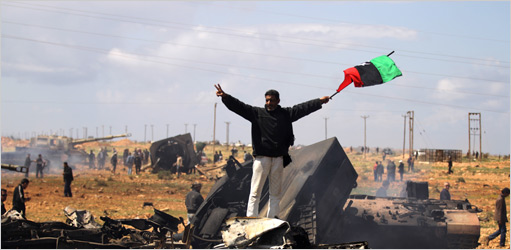
Libyan rebel waves the Libyan flag atop a destroyed government tank.
The Region- The most obvious similarity between Libya and Iraq is one of geography and religion- both countries are in the Middle East and have majority Arab Muslim populations. It’s easy to dismiss this as glossing over a number of important differences, but I would caution against such an approach. The fact is that it does matter to many people that the US and our Western allies seem selectively focused on the Middle East while ignoring human rights abuses and humanitarian crises in other parts of the world (Burma, for example).
This criticism is similar to that levied against the International Criminal Court (ICC)’s selective prosecutions of only African conflicts. Skepticism on this issue can undermine how the world, and more importantly Arab populations, view the legitimacy of the UN and US actions and potentially re-raise a number of the neo-colonialism charges that so damaged America’s reputation from the handling of the Iraq invasion and subsequent occupation.
No Fly Zone Again– The US and her allies established and enforced two separate NFZs over Iraq from 1992 until the “conclusion” of the Iraq invasion in 2003 (once the US officially occupied Iraq under our “rebuilding” rationale, the NFZ was quickly lifted). Like the Libyan NFZ, the Iraq NFZs were premised on humanitarian grounds, specifically to protect civilians, the Kurdish populations in the North and the Shiite Muslims in the South.
The Usual Suspects Advocating Military Force in the Middle East- Just as with Security Council Resolution 1441 (declaring Iraq to be in material breach of WMD disarmament and the pre-text for the US/UK unilateral invasion), Resolution 1973 was co-sponsored and heavily supported by the UK and US. The Iraq NFZs were also jointly operated by the US and UK (with Turkish participation). There are non-nefarious explanations for this, mainly the reality of which countries have the military resources to actually enforce anything the UN authorizes and whose support is therefore critical.
The recent history of the US and UK in Iraq is also the reason you may be hearing people refer to fears of “mission creep”- the steady expansion of a military mission beyond its original mandate and purpose. Resolution 1973 is limited in its scope and mission and expressly bars any ground occupation. But, Resolution 1441 expressly did not authorize invading Iraq, yet that didn’t prevent the US and UK from dishonestly using it for that purpose. The UN, like any organization, is only as effective, disciplined and honest as the nation states that make up its membership. For this reason, many view any US/UK advocacy for military involvement in the Middle East with a great deal of alarm and question the “real” motivations of these two countries’ constant warmongering positions.
Middle Eastern Countries’ Participation- The Arab League’s endorsement of the Libyan NFZ has been hailed as a remarkable step and a move that inoculates Western powers from neo-colonialism claims in attacking Libya.
The Arab League never endorsed, as a group, the Iraq NFZs or the Iraq invasion, but these events did have Middle Eastern nations’ participation. Turkey officially participated in the Iraq NFZ enforcement, twice passing legislation extending Turkey’s military involvement. And, while technically no Middle Eastern country was included in the “Coalition of the Willing,” Bahrain, Kuwait and Qatar all allowed the US and UK military to launch the Iraq invasion from their countries and provided air and ground access into Iraq. While Arab League members’ involvement in the NFZ is substantially greater (Qatar and UAE jets are involved in enforcement actions over Libya), their involvement, in itself, does not particularly distinguish Libya from Iraq.
Western Accountability Lacking Again– Saddam Hussein was prosecuted for crimes against humanity by the Iraqi Provisional government. However, his conviction and death sentence was based solely on the murder of 148 Shiites following a failed assassination attempt in 1982. Left out of the trials was any evidence related to crimes against humanity that were carried out with American provided weaponry and, in some cases, with US knowledge that the arms and weaponry would be used against civilian populations. Documents declassified by the National Security Archive spell out US involvement in installing and arming Hussein and, as reported by the Washington Post, “Americans drafted many of the statutes under which Hussein and his associates [were] tried.”
The US and UK, like with Iraq, have provided Gaddafi with many of the arms his military is using in committing potential crimes against humanity. Resolution 1970 gives the ICC jurisdiction to investigate these crimes, but is limited, some would say specifically to avoid US and UK accountability, to actions after February 15, 2011.
Will we one day say Libya intervention, 2011: Another Iraq?
For the reasons listed above and many others, many people watching the situation in Libya feel a creeping sense of déjà vu as these similarities revive unpleasant memories and serve as a powerful reminder that the noblest intentions (I’m being charitable here!) can lead to great, potentially irreparable harm. With that in mind, the second and final installment in this series will focus on why the situation in Libya is not like Iraq, but also acknowledge how it could become, in the future, the next Iraq.
Read More
For an excellent interactive feature on the Iraq NFZs, see here.
For an overview of the Iraq NFZs enforcement, questionable legality and a list of US/UK military strikes in Iraq based on NFZ breaches, see here.
I know what you’re thinking. It’s Utah. What craziness could ever happen there? It’s totally not an insane mix of hillbilly death cult and fly-by-night Xango pyramid scheme zombies.
Well apparently they took a break from telling their third sister-wife to “STFU MARGENE OR YOU’RE GOING BACK TO THE “BAD” COMPOUND” and finally got around to some important state business:
(CNN) — Until this week, Utah had 24 state symbols, from tree (the blue spruce) to insect (the honeybee) to even cooking pot (the Dutch oven).
Now it’s added an official state firearm — the John M. Browning-designed M1911 pistol, becoming the first state in the nation to have one, according to the state legislator who sponsored the law.
Utah Gov. Gary Herbert signed the new symbol into law this week.
Look out, Arizona. Utah just made you its BITCH. Apparently this initiative was the brainchild child of something called a “State Rep. Carl Wimmer, a Republican who was a police officer and SWAT team commander.”
“There was more controversy than I anticipated, but it really passed with bipartisan support,” Wimmer said. “One of the biggest comments from the critics was that we should not honor an implement of death. And my response to that has always been that this firearm does not represent an implement of death. It represents an implement of freedom.”
YEAH. Guns aren’t deadly weapons. They’re all about giving freedom. Such the freedom to defend America from your fourth sister-wife WHO JUST FUCKING CANNOT LEARN HOW TO WASH THE DISHES RIGHT AFTER DINNER.
Well, why not? Let’s understand something first. You never HAVE a kitty. The kitty has YOU. In The Sims 2, a dog goes from Stranger to Friend to Master, and a cat goes from Stranger to Friend to Mine. Someone at EA Games understands cats, really, REALLY well.
Oh, dogs are wonderful. There isn’t anything like a Golden Retriever or a Chocolate Lab or best of all, a German Shepherd. A Shep will give his life to protect you, your wife and kids. A cat will do this too. But it’s more like a favor than an obligation. I’ll never understand “dog people” vs. “cat people”, though frankly I think cat people are smarter. That said, I just love animals, and if my space was bigger, a German Shepherd puppy would be a lifelong friend of mine, well until his whiskers turned gray.
But cats. Especially smart breeds like Siamese or Maine Coons or Orange Tabbies. There is nothing like coming home to a furry friend who meows his face off to say hi. I pick up our Maine Coon Tuxedo cats every night when I come home, because they yowl if I don’t. Edmund rubs his head on mine, and Lucy buries her face in my neck. While they cuddle with me, when it’s Mike’s time to come home they stand at the door and bitch him out, like “Where the hell WERE you?!?!” Once that’s done, it’s all about dinner. Mike sings the “I got a can!” song and they yowl and it’s pretty damn hilarious. My life is kinda awesome because of this. Yeah, because cats are imperious and snotty and not affectionate. Not.
Let’s not understate dogs. A cop in Penn Station a couple of months back had a great conversation with with his canine buddy. Very politely, he said “Ouw, ouw ouw!” The dog looked at the ceiling and let out the most amazing , echoing “Arooooo!” I’ve ever heard. People applauded.
So both kinds of animals are Man’s Best Friend. Cats have dignity. Dogs have respect. Both are our very best companions.
Another crazy thing that cats and dogs both do is that they know when you’re sick and they sit right by you as you recover. They detest the smell of Nyquil and Robitussin, but it does not matter. That cat or dog will sit by you until you are well. Doctors have issued a clinical study that a purring kitty reduces stress. I’ll go out here and say that a dog laying his head on your leg does the same thing.
In short, it’s only an either/or thing if space and time is an issue. Dogs need more room and more maintenance. It’s not fair to either of you to have one if you can’t care for one properly. Get a kitty instead, if that’s your deal.
Since the passing of UN resolution 1973 which authorizes a No Fly Zone over Libya and authorizes “any military or preventative measures” to protect Libyan civilians and civilian areas “while excluding a foreign occupation force of any form on any part of Libyan territory” things have moved quite quickly. The first shots of the UN forces have been taken by French fight jets, opening fire on four Qaddafi tanks and other military vehicles. It is unclear as of now whether this will lead to a ground-force invasion in the upcoming days.
Al Jazeera is reporting witnesses as saying Qaddafi’s forces are trying to storm Benghazi from the coast and the south.
The BBC has video of a fighter jet being shot down over Benghazi which may or may not belong to Qaddafi forces and a BBC journalist in Benghazi says he has seen pro-Gaddafi tanks inside the city, presumably the ones that have been blasted by the French jets.
The BBC has excellent live coverage of the ongoing crisis.
Update 3:06pm: A US defence official tells Reuters that the US Navy has three submarines in the Mediterranean preparing for operations in Libya.
“Prime Minister David Cameron is currently with members of his cabinet in front of a video wall planning operations, our correspondent adds.” Damn, war is so futuristic now.
Update 3:18pm: The jet was a rebel jet. They shot their own jet down.
Update 3:49pm: The Guardian confirms that the rebel’s only fighter jet was shot down by Qaddafi forces.
Update 3:53pm: The BBC is reporting that the US has launched Tomahawk cruise missiles at targets inside Libya.
Update 4:01pm: Reuters quotes a senior US military official saying US, British, French, Italian and Canadian forces are to launch a strike along the Libyan coast.
Nothing says Rock and Roll like conservative America. Just ask The National Review. While you may not think of the county Republican meeting as a swaggering display of animal sexuality, it is that pro-freedom passion that makes conservatives rock. Just ask the Ted Nugent.
Now that is presidential!
So here is a collection of the best Rawk the Tea Party has to offer. Feel free to bookmark these videos so you will have something to watch when you hang out at you aunt’s house in Arizona next Christmas.
This chick has sort of a Laura Branigan thing going on. Unfortunately, no one told her that the use of the word accountability in a song sucks most of the rock right out. However, she does get points for dramatic lighting.
Here is a classic from the health care debate. Try to resist dancing in front of your computer.
This guy is really trying to rock in a sort of Mr. Mister sort of way. However, he really needs to rethink the Naziesque gray shirt combo, especially while bitching about the British. Don’t live the stereotype, dude!
Here is a low-fi treatment. This guy wants freedom like Lou Reed wanted junk. This is what happens when you bundle Garage Band and IMovie on new Macs.
OK, I can’t leave this without at least one country song. This is epic and contains stars and stripes burqas. Warning: The viewing of this video will make you afraid to ever visit The National Mall.
As Japan races against time to get its Fukushima nuclear reactor under control, questions are being raised about quality of leadership in this time of crisis. As of this writing, the alert level of the reactor has been raised to 5 point (out of 7, on par with the Three-Mile Island incident), there are about 15,000 people dead or missing and another 440,000 people in evacuation centers. From the regions north to those surrounding Tokyo, residents are trying to go about their lives while worrying about their relatives, fearing dire radiation poisoning, trying to find non-existent food in stores, hastily planned rolling blackouts that have been implemented by the government to save energy, limited train service, limited bank service, no fuel for heat and transport, and an ever-present fear of aftershocks. Cities located further out like Osaka, Kobe, and beyond are trying to deal with a sudden influx of people trying to escape the areas deemed affected by the radiation
Prime Minister Naoto Kan
Clearly, this is a time when people are looking to strong leadership to help them find strength and hope. Prime Minister Naoto Kan doesn’t seem to be that person. Up until this earthquake, popular opinion of Kan was in the 20-percentile range and it looked likely that he was going to resign despite statements to the contrary. Kan came into power by a historical defeat in 2009 of the conservative Liberal Democratic Party (LDP) by the Democratic Party (DPJ) to take the leadership. There were high expectations and the defeat was in answer to the recent economic crash. Up until then, the LDP had controlled the government for 54 years with the exception of a short time in 1993. The defeat was momentous.
When the earthquake struck, Kan quickly sent troops into the worst affected areas and shut down reactors that posed a risk. However throughout this crisis, the general public sentiment, and indeed, that of the world has been that Nagata-chou has not been forthcoming with critical information regarding nuclear safety. For starters, there has been a striking lack of frequent, direct communications from the Prime Minister, allowing the Chief Cabinet Secretary Yukio Edano to be the face of the government. He has been the link for people who are grieving and has grown so popular (and thus reinforcing the unpopularity of Kan) that there has been concern on the part of the public that he has been “too much” the face of the crisis. Twitter channels have popped up with hashtags such as #Edano_nero (Edano, go to sleep) and #Kan_okiro (Kan_wake up). Part of the reason for the huge connection he has stirred within people is because he has not been the standard politician, favoring instead to speak directly and not with a script. Kan has yet to go to the affected area, saying that he is considering going next week, almost two weeks after the tragedy.
But despite that, are they giving enough information? One of the main reasons being considered is that there is a possibility that the government has been withholding information because it has not wanted to induce mass panic. The average Japanese in Tokyo has now been required to go back to work and is trying to resume life as usual. However, countries like the US, France, Hong Kong, and Germany have been sending in charter flights for people wishing to go to Osaka or leave the country entirely. When the head of the Nuclear Regulatory Commissions, Gregory Jaczko commented on the danger level due to the lack of water in the cooling pools of the number 3 and 4 reactors, Edano, avoided comment. According to the New York Times on March 17th,
Japanese officials did not flatly deny Mr. Jaczko’s comments but hedged. Asked about the level of water in the No. 4 reactor, Yoshitaka Nagayama, a spokesman for Japan’s Nuclear and Industrial Safety Agency, said: “Because we have been unable to go to the scene, we cannot confirm whether there is water left or not in the spent fuel pool at Reactor No. 4.
The technical nature of the issue perhaps compounded the Japanese news media’s tendency to shield the government. Reporters who cover agencies and ministries are organized in press clubs that have cozy ties with officials and decide what to report — and what not to. The lack of attention received by Mr. Jaczko’s comments was consistent in the news media.
The position of the government is that they’ve been honestly conveying information despite an admission that they might’ve gotten it out more effectively earlier on. Kan had blown up at Tokyo Electric Power (TEPCO), the plant’s operator for not providing sufficient information.
In all, the government reaction has been seen as a crisis in lack of forethought and mismanagement. While, the double hit of earthquake and tsunami might have seemed impossible, it is baffling that no one had the forethought to make a causal connection and make plans accordingly. Hopefully, the government will use this as a wakeup call and step up to become one that the people want so desperately to believe in.