Culture and Arts

526 posts

Thought For Food – Cookbooks Meant for Reading

Most cookbooks spend a life of solitude on a dusty shelf only pulled down to have sauces splashed on them for special occasions.  The following two cookbooks deserve to be enjoyed in front of a fireplace with a glass of wine just like your torrid romance novels.

The Physiology of Taste
Jean Anthelme Brillat-Savarin

As Henry Fielding was to the English novel, so was Jean Anthelme Brillat-Savarin to the literature of gastronomy. It was Brillat Savarin who first said, “Tell me what you eat, and I will tell you who you are.”

If you’re a serious cook, this unusual volume will be old toque to you. But I’m surprised again and again at how often Brillat-Savarin slips below the radar of so many readers, even some who, like your humble servant, read cookbooks just because!
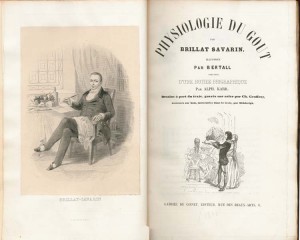
The Physiology of Taste
Jean Anthelme Brillat Savarin's Frontispiece and Title Page

His peerless masterpiece (title translated from the original French) was The Physiology of Taste, or Transcendental Meditations on Gastronomy, theoretical work, history and agenda, dedicated to Parisian gastronomy, by a professor, a member of several scholarly literary societies.

Originally published in December 1825, two months before Brillat-Savarin died, it’s a wonderful mix of 19th century French gourmandise, Enlightenment curiosity, and high spirits – this is a man with whom one might dine every day for a year and he’d never run out of food lore and opinion … or aphorisms and wit.

According to Wikipedia, remarkably, The Physiology of Taste

“… has not been out of print since it first appeared, shortly before Brillat-Savarin’s death. Its most notable English translation was done by food writer and critic M. F. K. Fisher, who remarked “I hold myself blessed among translators.” Her translation was first published in 1949.” — (Wikipedia)

There are recipes, though they’re more like vivid descriptions of a dish than precise, detailed directions as we know them. There are stories such as one might have heard over port a few years after Waterloo, expansive and entertaining table talk, part fabliau, part restaurant review, and part philosophy, scientific and spiritual alike.

Let’s consider Chapter VI: On Food In General. After a brief essay on bouillon and boulli, the boiled meat whence bouillon comes, Brillat-Savarin moves on to poultry, with particular fascination for the North American wild turkey; this leads in turn to the tale of a 1794 American turkeyshoot in which he participated. Next he strides in seven-league boots through the categories of game, from thrushes, snipe, partridge, quail, and rabbit, to wild boar and roebuck. Finally he turns to the piscine world and explains why fish is less nourishing than meat but a far more potent aphrodisiac.

Then he pauses to recount the story of a crustacean-mad colleague  with whom he shared a dinner: both men consumed three dozen raw oysters apiece, at which point Brillat-Savarin called a halt while his dining companion feasted on, consuming no fewer than thirty-two dozen oysters before the two tucked into the main course. All of which leads to the following marvelous Philosophical Reflection:

“Fish, by which I indicate all species of it considered as a whole, is for a philosopher an endless source of meditation and of astonishment.

“The varied forms of these strange creatures, the senses which they lack and the restrictions of those they possess, their different means of existence, the influence upon this of the places in which they must live and breathe and move about: all these things extend the world of our ideas and the limitless modifications which spring from matter, from movement, from life itself.

“As for myself, I feel something like a real respect for fish, which comes from my profound persuasion that they are plainly antediluvian creature; for the great Flood, which drowned our grand-uncles toward the eighteenth century of the creation of the world, was for the fishes no more nor less than a period of joy, conquest, and festivity.”

The Physiology of Taste abounds in such passages, as well as stories, scientific speculation, ecclesiastical and military history, not to mention a thorough primer on dangerously stimulating foods like the highly erotic truffle, and coffee, widely regarded as the crystal meth of its day. Brillat-Savarin explains why apothecaries prescribed and concocted various mixtures of chocolate as medications, and offers expert advice on how to hang, age, and stuff a pheasant with a pair of woodcock to make a gamy but unforgettable hunters’ meal. Not merely a book about food, this surprising, wide-ranging work is a treatise on late 18th- and early 19th century European life and world view, gathering into its capacious apron everything from natural philosophy to Napoleon’s various appetites to a vignette of a pretty demoiselle gourmande feasting at a groaning board; it’s a truly delicious book, fascinating, irresistible, and shot through with the profoundest pleasure at nature’s bounty. Even if it doesn’t seduce you into full-blown foodie-hood it will give you a new understanding of why the people who are passionate about food and cooking are the way they are.


Modernist Cuisine: The Art and Science of Cooking

Nathan Myrhvold, Chris Young, and Maxime Bilet

At a list price of $625 (but knocked down at Amazon.com to a frugal $460 and change) the new cookbook from former Microsoft Chief Technology Officer Nathan Myrhvold is described by Tim Zagat as “The most important book in the culinary arts since Escoffier.”

Even to describe Modernist Cuisine as a “book,” while true, is nevertheless rather misleading, something like comparing the US Army Official History of World War II with Norman Mailer’s The Naked and the Dead. Myrhvold and his co-authors spent a substantial Microsoft-generated fortune to create a no-expenses-spared Cooking Lab where a staff of 20 have created entirely new and astonishing flavors and extraordinary textures using equipment more suited to a chem lab than to a kitchen: autoclaves, water baths, homogenizers, vacuum chambers and even centrifuges, to work postmillennial magic on scary-sounding ingredients like hydrocolloids, gels, emulsifiers, enzymes, and foams.
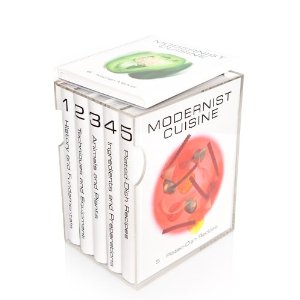
Modernist Cuisine
Futurist Food is Now

The package itself is military-industrial in scale: six oversized volumes totaling 2,400 pages and weighing 50 pounds, illustrated with thousands of photographs and diagrams. The authors, scientists all as well as accomplished chefs in their own rights, have followed the path blazed by such pioneers of ‘molecular gastronomy’ as the Adrìa brothers at the Catalonian restaurant elBulli, named five times since 2000 as the best in the world, or Heston Blumenthal, who has led the Fat Duck, 25 miles from London, to its own 2005 Best Restaurant title.

The exotic gizmos and the bizarre though wonderfully tasty foodstuffs they produce tend to get the lion’s share of the food-critical attention (and not a little skepticism from much of the high-end gourmet world) but Myrhvold, Young, and Bilet haven’t limited themselves to cool futurist cuisine; their ambition is nothing less than to provide an encyclopedic reference to cooking in all its myriad aspects. There’s an entire chapter devoted to water, and your trusty old wok gets the same respect and attention as the latest in sous-vide technology. If you’re not so sure about splots and splashes of Day-Glo sauce deployed with a casual yet utterly calculated flick over a frothy confection that might have started out as a scoop of bone marrow, you should know that one reviewer declared the Modernist Cuisine‘s version of Mac’n’Cheese the best ever created. The book examines and explains everything: you’ll get all the usual methods (and some all-but-unheard-of techniques too) but you’ll also get detailed explanations not only what will come out of any given beaker, Klein bottle, or cast-iron kettle but also what is happening at every stage of the cooking process, whether a time-honored roast or a day-after-tomorrow centrifuged smoothie.

Meats alone get more than 250 pages of comprehensive coverage, and over 300 more present recipes created by many of the world’s most accomplished chefs. And while some of the more recherché machines and elaborately futuristic processed creations are sure to daunt all but the truly stout of heart, this encyclopedic reference to the culinary arts and sciences is a book that gets about as close as it’s possible to get to being all things to all cooks.

We began this week’s reading with one of the earliest literary endeavors that could in some way be described as a cookbook — written by a bon vivant who was also, by the lights of his age, a scientist. It seems, then, entirely fitting to close with the admiring words of David Chang (of Momofuku fame ) who described Modernist Cuisine as “the cookbook to end all cookbooks.”
Dinner Conversation Starters- Fun with Bookshelves Contest!

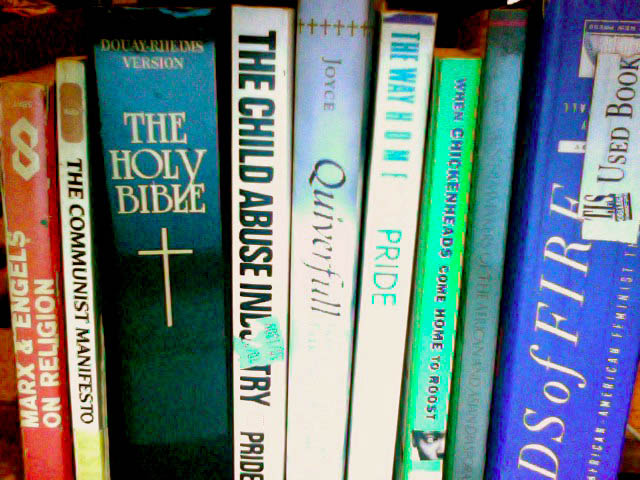
I’m sure you are all familiar with the advice of  “three things not to talk about at a dinner party: religion, politics and race.”  Well, I have something of a perverse sense of humor, I admit.  So, here is a current picture of my bookshelf, completely visible to any unsuspecting guest who may come to visit (I don’t really cook, so they wouldn’t be coming for dinner.  But, maybe drinks!):


From right to left, the titles are:

  • Words of Fire, An Anthology of African-American Feminist Thought
  • Women Filmmakers of the African and Asian Diaspora
  • When Chickenheads Come Home to Roost: A Hip-hop Feminist Breaks It Down
  • The Way Home: Beyond Feminism, Back to Reality
  • Quiverfull: Inside the Christian Patriarchy Movement
  • Child Abuse Industry
  • The Holy Bible
  • The Communist Manifesto
  • Marx and Engels on Religion

Are you like me?  Do you take perverse joy in placing provocative (or scandalous!) reading material in plain view?  Ever forgotten about them until poor Grandma came to visit?  If so, submit your photo (re-arranging for purposes of this contest is allowed) or, if you don’t have the books anymore, your best story about your inappropriate reading habits and the hilarity and/or awkward moments that ensued!  Best submission will win the honor of declaring yourself “Most Inappropriate Crasstalk Book Owner Of 2011” (trophy and certificate not included in award).

What No One Told You About The Gift of the Gab

With St. Patrick’s Day around the corner, this started out as a diatribe about how everyone who drinks green beer is going to a special hell. However, I realized, why not actually use this as a time to inform everyone of the things that I find great about my culture! That seemed much more constructive then yelling at you kids to get off my lawn. So, let’s start out with the part that I’ve always loved: folklore, legends and myths. Of which there’s a lot, so I’m gonna give you the Cliffs Notes version of what are referred to as the Three Sorrows of Storytelling, high edited and condensed by a partial, prejudiced and ignorant storyteller.

The Fate of the Sons of Tuiren

The father of the sun God, Lugh, was walking down the road and came across three boys who didn’t like him, like boys do. So they stoned him to death. Lugh found out and was pissed, and demanded a blood debt. He asked for three apples, and the skin of a pig, and a spear, and two horses, and a chariot, and seven pigs, and a dog’s whelp, and a cooking-spit, and three shouts on a hill, and then proceeded to mock them saying that if they were too weak, he’d take some of it off. The boys quickly fell into the trap, and accepted, only to find out that the apples were from the Garden of the Hesperides, the pig skin was a magical skin that could heal any wound, the spear was a poisoned spear belonging to the King of Persia, the horses can travel on land and sea . .  and I think you get the idea. The boys set out and actually went made good on their promise.  Adventures were had, until they got to the hill, where they fought the warrior who was set to make sure NO ONE shouted from the hill, the boys were gravely injured, though still managed to yell off the hill. They brought the stuff to Lugh, and asked him to heal their wounds. He told them that it would be better for them to die a heroes death, now that they’ve acquired all this swag for him, and let the boys die. When their father heard that his sons had died, he died of grief as well. Fin.

The Children of Lir

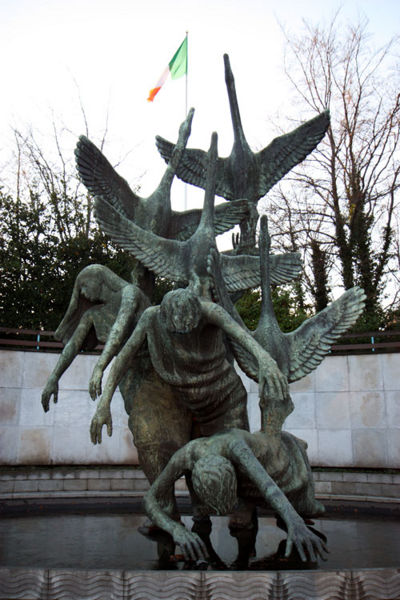
Sometime after this, the tribes were trying to decide on who should be High King over Erin. The God Lir realllllly wanted it, but they went with some other guy. In return, however, he got to marry the guy’s daughter, Eve. For a while, the two were happy, and Eve bore Lir two sets of twins, but died giving birth to the second set. The High King felt that no man should be alone, so he sent is second daughter, Aoifa, to console her sister’s widow. However, as Sondheim wrote, you can never love someone else’s children the way you love your own, so Aoifa started getting jealous, and eventually turned her step-children into swans, and cursed them for 900 years. When Lir found out, he turned her into a demon of the air, even though she was REALLY sorry for what she did. The four kids had to stay at a pond near their father’s house for 300 years, which was cool, cause they could talk and sing, but eventually, they had to trek out to the sea between Erin and Alba and spend the next 300 years there. Afterwards, they came back to Erin, happy to see their family, only to find out that everyone went and died on them, and that Christianity took over everything. The pond they were at was near a church and the priest befriended them. They became somewhat famous, and finally a pricness of the North married a Prince of the south, and wanted to do it in the church of the swans, which ended up breaking the last part of the curse. The 900 year old children were restored to their humanity, only they were 900 years old and died on the spot. The priest buried them and everyone was sad.

Deirdre of the Sorrows

A man and a woman had a beautiful daughter. She grew up in peace and happiness, but her parents knew she was doomed to fuck some shit up. Eventually the king saw her and fell in love, and took her back to his castle to foster her, and as soon as she became legal, get it on. She had it in her mind that she’d only love a man with hair as black as ebony, and skin as white as snow and lips as red as . .. well, I think we’ve heard that elsewhere, and you get the picture. There was only one such man, named Naoise, and he had two brothers. They met and fell in love, and the three brothers ran away with Deirdre. Furious, the king followed them, disrupting their happy life and what I would imagine would be the two other brother’s sexual frustration. He eventually caught up with them, and there’s a bunch of different version of how, but eventually everyone dies. (no, seriously, there’s a bunch of versions. In one, the brothers die by tripping on poisoned rocks and Deirdre dies from grief. Another, the boys die in battle and she dies after the king insults her after forcing her to have sex with another man.)

So, there you have it! Think of the long tradition of Irish storytelling this weekend, while you’re downing your green bud light, or your car bombs, or trying Guinness for the first time. And as Londonderry Aire (aka Danny Boy) plays for the 500 millionth time, and the drunk next to you starts singing the wrong worlds to When Irish Eyes are Smiling, think back on these stories, and on the Ireland that was before all the shamrocks and leprechauns.

Music Therapy Is Fake, Right?

What is music therapy? Why, it’s the therapeutic use of music, provided by a board-certified music therapist! What does that mean? It can mean a lot of things, but today, with the help of my father, I’m going to tell you a bit about music therapy in hospice.

Back when my dad wasn’t in the fast-paced, jet-setting career he enjoys today, he volunteered at a hospice during his free time. For those of you not in the know, a hospice is a place that cares for terminally ill people, who usually have less than 6 months to live. My dad’s job was to keep a woman company for an hour or two a week. We’ll call her Anne. She was in her mid-nineties and as smart as could be, though unable to walk. Dad was very interested in her childhood growing up on a farm, and on the second or third visit, he brought his fiddle to play for her. He played polkas, jigs, and reels, though Anne was partial to waltzes.

http://www.youtube.com/watch?v=_Ek3eCbfqp0

Note: If you’re going to be a music therapist, you’re going to need to know this song.

In short order my father started getting requests from other staff members to play for their folks. “Most of my visits were in the morning. At some point, I stayed and played through lunchtime. Staff members told me that the residents were generally more calm and ate better when I was playing, although I remember some being distracted from eating by my playing too.”

One man in particular loved the music. He was in a wheelchair, and generally non-responsive, but when the music began, he would grunt and rock, and his eyelids would flutter, though his eyes stayed closed. Those who knew him knew what the movements meant and how wonderful the music was for him.

“Another patient, a very sad one, was an ex-physics professor who, I am told, was a professional caliber violinist.  He was clearly very far away mentally.  He did sit to hear me play and he held out his hands to touch the violin, but I do not know how much he was understanding.”

My father is not a board-certified music therapist. He just wanted to help make some people’s days a little brighter. But he inspired me to begin my studies in music therapy as an undergrad, and to pursue the wealth of research in music therapy and the use of therapeutic music. With my rich education, clinical experience, and soon, my six-month internship, I discovered how to use the different parts of music – rhythm, melody, pitch, lyrics, instrumentation, and especially cultural or personal significance – to achieve meaningful, nonmusical goals.

In hospice, this may be helping a patient manage their pain, reflect on their life, work through grief, and think about their own mortality. You’ll also find music therapists in schools, hospitals, physical and substance rehabilitation centers, psychiatric units, and in private practice. We work with people of all ages on social, emotional, physical, mental, academic, and spiritual goals – helping a child on the autism spectrum build a tolerance for noise, leading discussions on sobriety, motivating a patient with a traumatic brain injury through their rehab (Rep. Gabby Giffords made leaps and bounds with her music therapist), and so much more.

Music therapy can only be provided by board-certified music therapists, but that doesn’t mean we have a monopoly on music itself! You don’t have to take classes, or even know how to play an instrument, to enjoy and benefit from music. Just play your favorite song, or breathe deeply and hum your own tune. See? You already feel better.

Scandinavians Do It Better

Do you suddenly feel a warm embrace of serenity emanating from your computer screens? Are you tired of the soul-crushing experience of clutter or hoarding and know deep down inside there’s a “better way” of living through design?  Well, dear Crasstalkers, today’s post will be one of many columns about a group of magical people who live in the magical lands of Scandinavia. Continue reading

Crass Fiction: Eternity By Chance

It is in solitude – always in solitude – that the guard of my masculine nature and identity ebb. Then, my genderless awareness of my humanity fully unfolds. It is then that I feel her presence most powerfully: when the prolific psychic residue of the ‘motion in stillness’ that she embodies lingers. The words ‘intuitive’ and ‘aware’ do not even begin to describe her effortless yet omnivorous understanding, her brilliant tabula rasa mind, and her remarkable capacity for profound tenderness.

In the wake of feeling her gentle yet phenomenal presence – and the subtle but unmistakable void of her absence – my apartment looks exactly the same to the naked eye. But whole new, transcendent worlds have been birthed from our symbiotic visceral reciprocity.

Our always-immanent metaphysical attraction seems to be taking the course of our lifetimes to evolve into something more carnally fulfilling. If our sexual expression ever equals the intensity of our exquisite rapport, we will both be willingly consumed by an ever-expanding concatenation of exuberant, balls-to-the-wall stamina marathons of athletic eroticism.

Tonight, she held me cradled in her lap, ensconced in her impossibly comfortable curves and silky soft skin. With sensitively skilled fingers, she unwound my stressed muscles in a masterfully knowing massage that was an extended foray of deep-release bliss for me. Beyond tension relief, it was an overall amelioration of my well-being.

Her instinctive talent for nurturing is as inexhaustible as my own need to be so thoroughly nurtured. It is a powerful reverence which bypasses romantic notion: the unconditional embrace of the Cosmic Mother. In truth, no one had ever held me as compassionately and adoringly except for my own mother, and that was a distant memory from many years ago.

Delicately, she broke the sweet spell of our shared silence by gently kissing my forehead and saying only, “Namaste.” (This translates roughly as the light, or the highest good in me salutes the light, or the highest good in you). It was a simple gesture and a single word that nonetheless felt like the fruition of the covenant of the holiest of Holy Grails.

Feeling starry-eyed and consummately relaxed, I slowly roused from the altered states that her extended healing had induced in me. Propping myself up on my elbows, I then turned to face her. Then I leaned in to meet her in an eyes-wide-open, serenely ravenous and lingering tongue-kiss. Many mind-blowing moments later, she broke the magnetic connection of our osculation by touching her fingers lightly to my face.

In a sultry tone which did not belie her seriousness, she said, “When we have more time, we will do far more justice to this. If I possessed the skill to alter the time/space continuum – and the unforgiving rhythms of our earthly lives – I would have you with me for hours, days, weeks, months, years… into timelessness. Until then…”

I held her to me and finished her sentence aloud, saying, “Farewell is never goodbye.”

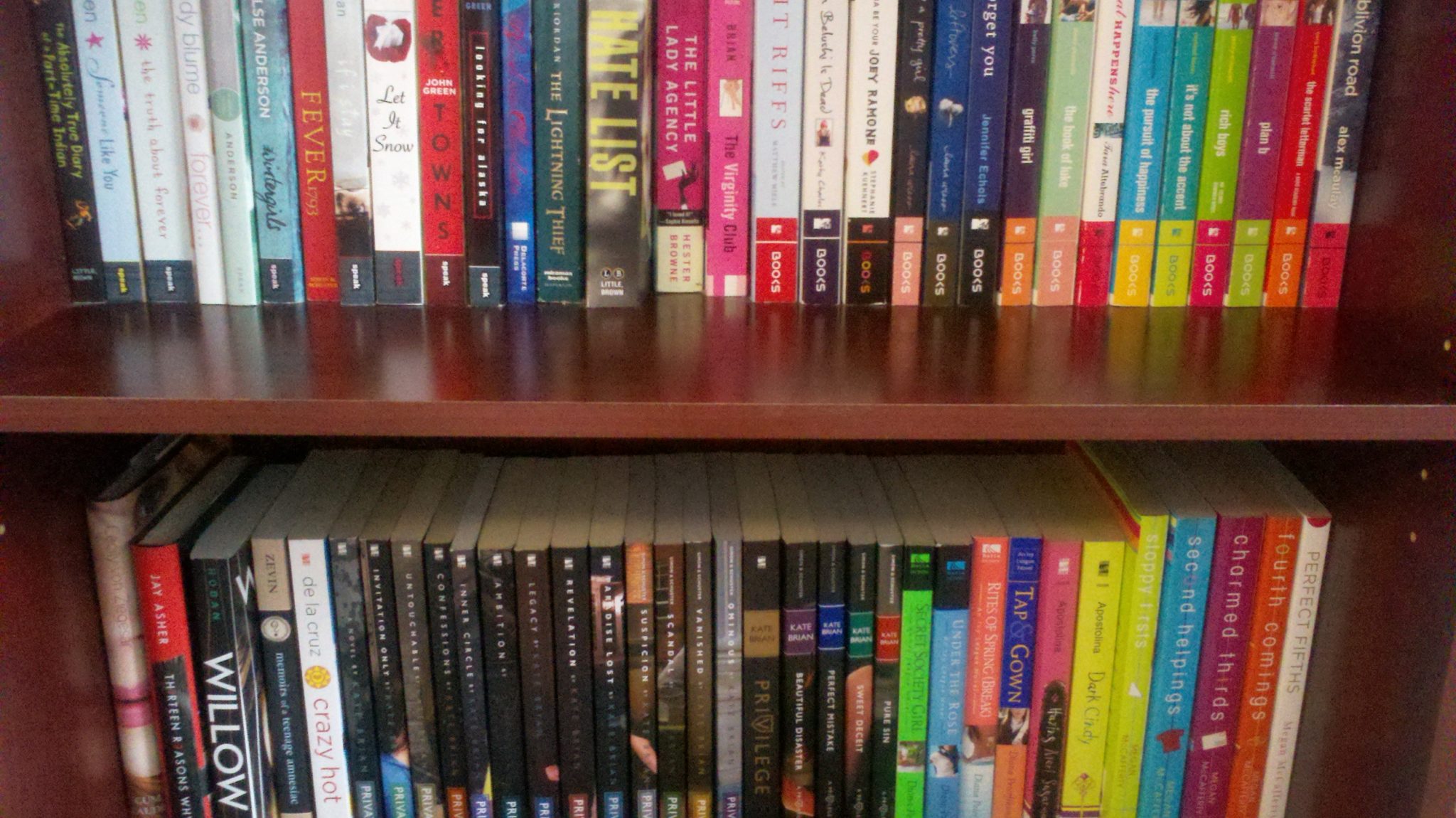
YA Lit: Putting the “Adult” in “Young Adult”

I’m pretty officially an adult. I have a full-time job, a full-time husband, full-time bills, and a part-time metabolism—all signs that I’ve officially passed the point where I have to get nervous about being carded. And yet, when it comes to literature, my genre of choice is more appropriate for a high-school library than my own personal one, and as book sales have shown, I’m hardly alone.

So what is it about young adult literature that is so damn appealing to those of us who could just as easily be reading books for grown-ups? And, more importantly, why do we want to send ourselves back to high school when we spent four years barely managing to claw our way out of it?

In that latter question actually lies part of the answer—because it allows us to do it again as someone else. Weren’t in the popular clique? No problem—try again as Gossip Girl’s Blair Waldorf, Pretty Little Liars’ Hanna Marin, or Sweet Valley High’s Jessica Wakefield. Weren’t the smart standout who somehow manages to seduce an entire school no matter how much she stands out, blunders, or self-effaces? That’s OK–Private’s Reed Brennan and The It Girl’s Jenny Humphrey (yes, that Jenny Humphrey) have got you covered. Weren’t the princess of a totally made-up country? Princess Diaries Mia Thermopolous FTW! And let’s not get started on whether or not you had magical powers or fell into a love triangle with a vampire and a werewolf.

But of course, high school isn’t all about what we weren’t; it’s about what we were, and it’s those authors who so successfully encapsulate the enormous range of trials and tribulations of adolescence in their novels, from not having a date to not having a mother, that have turned YA lit into a must-read genre for all ages. High school is, in a manner of speaking, the last “shared American experience” before we all diverge in myriad ways; although we didn’t all go to college or vocational school or seminary, or become teachers or doctors or lawyers, we all spent the four years preceding those adventures in a fairly similar environment.

Because being a teenager isn’t like being an adult. The relationships between characters in your average contemporary young adult book don’t include the complications of marriage, divorce, and kids. The ways they choose to resolve the issues they face don’t have to take into account how they will affect their jobs or their children, or how they’ll continue to pay their bills. The young adult’s perspective is a selfish and narrow one in the most innocent meanings of those words, and one that I think all adults miss being able to have every now and again.

But make no mistake—there’s nothing lighthearted about today’s bestselling contemporary YA. The sci-fi/fantasy subgenres have proven that YA books can appeal to any age or gender, and in order to keep up, contemporary authors are now veering away from the old teen-centric topics like romance, social competition, and puberty, and replacing them with the types of subjects that possess the depth and universality to appeal to all ages in order to obtain a similar “crossover” appeal, creating a new sub-sub-genre which is all but officially referred to as “Edgy YA.” It’s a silly word choice—does anyone say “edgy” non-ironically anymore?—but the truth of the matter is that the boldness of authors covering major issues in the latest crop of books is nothing short of astonishing, and for teens who don’t even know how to begin discussing topics like rape, suicide, eating disorders, drugs, and school shootings, the value of having an author speak frankly on the subject in a book targeted to their age group is immeasurable.

For those interested in coming over to the dark side, a few recommendations for where to begin:

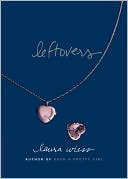
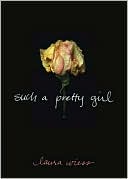
Leftovers and Such a Pretty Girl, both by Laura Wiess. The former is a unique look at the capability of average, relatable teens to do terrible things in response to abuse and abandonment; the latter, a book from the perspective of a teenage girl whose father is returning from prison early after being put away for sexually abusing her. I highly recommend both, but if you’ll only try one, make it Leftovers for its absolutely perfect final line.
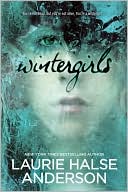
 

Speak and Wintergirls, both by Laurie Halse Anderson. Anderson is pretty much the mistress of edgy YA, and each of these books alone could justify why. The woman is brutal when it comes to honesty and detail, and Speak has, for years now, been the young adult novel about date rape. (If you read nothing else by LHA, at least read this post from her blog in which she addresses a professor’s claim that Speak is soft pornography.) In 2009, Anderson added Wintergirls to her list of publications, a chilling and powerful depiction of eating disorders from the perspective of an anorexic whose bulimic frenemy has just passed away.


Th1rteen R3asons Why by Jay Asher. Rarely has a standalone YA novel generated this much attention and praise so quickly. Throw in the facts that this was Asher’s debut and that it was just acquired by Universal and you’re looking at a bonafide literary phenomenon. This novel about teen suicide, told from the perspective of the boy who loved the girl who killed herself and left behind thirteen tapes to explain the motivations behind her actions, is not only a heartbreaker but an insightful look into how seemingly meaningless words and gestures can snowball into dangerous consequences when paired with an adolescent mind.


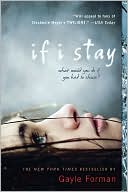
If I Stay by Gayle Forman. (NB: Clicking either the book or the link will be the littlest bit spoilery.) A heartbreaking work from start to finish, If I Stay takes place almost entirely within the subconscious of its heroine Mia as she lies in a coma following a car accident that’s just claimed both of her parents. As its title suggests, the book is an examination of her life up to that point as she struggles to decide whether her new life will be worth living or whether it’s time to stop fighting.


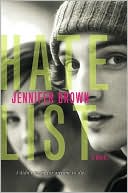
The Hate List by Jennifer Brown. This incredibly dark novel about the aftereffects of a school shooting–particularly on those who loved the shooter–is impossible to read without reflecting on the similar tragic events in our nation’s recent history. Told from the perspective of the girlfriend of the now-deceased shooter, who is still struggling to understand her role in the mass-murder, this book feels like a must-read for anyone who’s ever wanted to think about school shootings in any way other than as they’re presented by the media.


I’d also be remiss if I didn’t mention Before I Fall and Delirium, both by Lauren Oliver, although I have not yet read either one due to their not yet being available in paperback. They are both widely considered to be excellent, and I hope to confirm that as soon as possible.


Judy Blume, Patron Saint of Adolescence

Most importantly, however, I feel credit should be given where credit is due, and I don’t think any single person on Earth deserves credit for the propagation of frank literary dialogue with teens like Judy Blume. No author of books for teens has boldly faced down as much controversy as Ms. Blume for her books which address topics like puberty, masturbation, losing your virginity, and bullying. Judy Blume started the discussions no one was having, and if my word isn’t enough for you, perhaps the fact that a compilation with this title actually exists will do it.


Happy reading!


Crasstalk Fiction: The Antidote To Pandora’s Box

Somewhere in the middle of the sultry summer night, nature called. My lover unzipped the front flap of our tent and we headed outside onto the sand of a secluded beach cove along the southern California coastline. As we were alone, we exited the tent nude. A pleasurable breeze greeted us, briefly alleviating the swelter. Even with a nearly-full moon, the lush ceiling of stars above us was breathtaking. Adding to our overall feeling of auspiciousness, a shooting star fell seemingly directly in front of our path. My jaw dropped in awe, and I wondered aloud a most sincere approbation, “Oh, how you bless us God, life, spirit, universe…”

With that grateful invocation, my lover and I proceeded to relieve ourselves in the majestic ocean. (We rationalized that our good actions far outweighed this relatively minor infraction.) The shock of contrast between our warm bodies and the still-cool water was exhilarating. We dove under holding hands, then after we arose, we exuberantly collided in a delicious, playful kiss. As we separated our bodies ever-so-slightly, we noticed a captivating phenomenon: the bright light radiated by the moon cast us in an immaculately explicit, lucid shadow against the backdrop of pristine sand.

As we stood in the ocean, we were bewitched by watching the exquisite subtleties of our well-matched physiques. Every slow, sensual move we made was mirrored and magnified in the remarkable chiaroscuro of moonlight and shadow. In my heightened state of arousal, I felt my skin turn incarnadine, like a lust-drenched niacin flush. Without needing to accede, my lover and I met each others’ unspoken desires, choreographed in equal parts by erotic providence and spiritual syncretism.

Deliberately, we decided to delay the consummation of our mutual yearning until we got back to the tent. Both of us later confessed our suspicions that we might have literally drowned due to our sensual distraction. We returned to the tent giddy, overly-amped and very ready to merge our inner empyreans. As we made love, time became evermore malleable and fluid, its interstices seemingly yielding to our mutual need for extended, undulant erotic equanimity.

It was the ultimate power trip: we were reveling in the complementary, egalitarian nature of true inner power. Luxuriantly supine, I decided that if I had to die, I’d like to do it with him inside me, in precisely this position. But for the moment, I was ravenously consumed and consummately nourished by the vitality of living abundantly.

When I awoke a few hours later in the full illumination of dawn’s gorgeous color palette of light, my lover was momentarily gone. Resting on my belly was a velvet drawstring bag, sewn in the design of a labyrinth. Inside the bag was a smooth, flat dark-grey large stone that was a lapidary masterpiece. In Celtic-inspired calligraphy, it read in Latin:

ab ovo, ut terminus

et ab novus orsa

saecula saeculorum.

On the other side of the stone was the English translation:

from the beginning, to the end

and from the new beginning

to all eternity.

My lover returned in time to witness the resultant awe I felt at reading such lofty words which I had inspired. My stupefaction derived from being so comprehensively recognized and acknowledged by someone so much like myself. We kissed deeply, and as we prepared to delve again into erotic joy, I had an amazing epiphany:

Whole, healed lovers everywhere are the living antidote to Pandora opening the Box. By unleashing harmony, joy, understanding and reverence, perhaps we may break the spell of all the ills that have been cast upon this world.

Did Arianna Huffington Force Out Engadget Editor?

The bearded and bespectacled Engadget editor Joshua Topolsky has announced he’s leaving the fourth most popular blog in the country.  He gives no reason and says he has a few fantasy projects he might work on.  That translates to I have been fired and have no new job.

Engadget has been owned by AOL since 2005 when the founders sold the blog group Weblogs, Inc. for a reported $25M.  In that time they have had steady growth and are well regarded.  So, what changed? AOL purchased HuffPo and put Arianna Huffington in charge of the AOL blog empire which also includes the Techcrunch group of blogs.  It seems strange timing for the editor to “leave” unless Arianna wants to put one of her own in charge or Topolsky didn’t want to go along with the AOL Way.  This comes in the same week that AOL laid off 200 people.

Source and photo Engadget.

Spirituality Corner: All We Are Is Dust In The Wind

1977 was a difficult year to be a 9-year-old existentialist. This was the year that proffered the theatrical release of Star Wars – which introduced me to contemplations of a vastly cosmic nature: life, the universe and everything – and also the ubiquitous radio play of Kansas’ hauntingly gorgeous paean to mortality, Dust In The Wind. My already-insatiably questioning mind wanted answers, and I wanted them urgently.

Between my fervent pondering of the song and the film, I had my first “mid-life” crisis – yes, at age 9. I ate very little, slept constantly and was so depressed that my mother had to take me out of school for three months. Doctors had little to offer – this being long before the over-medication of children became commonplace – since there seemed to be absolutely nothing wrong with me. There were no problems at home that could be relatable to such a sudden and profound shift in my personality. I was blessed by a loving extended family, none of whom had any idea how to offer me any solace.

But clearly, there was something wrong with me. No matter how hard I tried, I couldn’t grasp the huge universal intricacies that I so desperately wanted to be able to wrap my growing mind around. Early on in my malaise, when I finally worked up the courage – I can feel my little hands balling up into fists remembering this – to ask my mother what the meaning of life was, she held me tightly and lovingly confessed that she didn’t know. She added that as far as she could tell, it involved being the best and most loving person you could be, and cherishing your family. It was a very sweet, earnest answer, but it fell far short of the explanation I’d been hoping to hear. Because she was not only my whole world, but had also been a science major in college, she was the only person whom I really thought could give me an answer.

So ensued my philosophical funk. I recall staring into the mirror, trying to figure out what was behind and beyond my eyes, my brain, my body. My family was profoundly supportive, although I’m sure my then-5 and 1-year-old brothers were merely bummed that I wasn’t around to play with. I’m not sure exactly what specifically pulled me out of my extended angst, although it probably had something to do with my mother and my maternal grandmother, similarly sensitive and tremendously giving, caring souls.

When I returned to school after a three-month absence, it was like being on an alien planet. I still sought my spiritual solace and grand-scale understandings, but my peers were content to do 9-year-old things as though they were all that mattered. Having spent so much time inwardly analyzing, I had come to the conclusion that if I came from nothingness, that’s where I would return when I ceased to physically exist. If I came from “somethingness”, then that’s also where I would return. It seemed pretty fundamental, but it brought me great peace after such single-minded turmoil.

I wrote this unflinchingly intimate piece to further the discourse we’ve been sharing in the comments of these spiritually-related posts. I am sure that many of you have had similar experiences pondering the meanings of life, death and all things in between, albeit perhaps not from such an early age. As always, you are most welcome to share anything that resonates with you to do so.

Whether or not you’ve ever heard Dust In The Wind, do not miss listening to this absolutely masterful live version of this stunning and eternally relevant song.

I wish you peace, and the answers to all of your eternal questions.